
agentic ai

From “Interesting” to “Useful”: Why Enterprises are Skipping GenAI PoCs in 2026

From "Interesting" to "Useful": Why Enterprises are Skipping GenAI PoCs in 2026

Over the past two years, Generative AI sparked a wave of Proof of Concept (PoC) enthusiasm across the corporate world, with diverse applications emerging at lightning speed. However, as we enter 2026, a distinct shift is occurring: enterprises are beginning to “skip the PoC” and move directly toward integrating AI into core operations.

International AI Safety Report 2026 》, which was released in February, highlighted a new risk known as “Goal Misalignment.” If the objectives we set for AI are imprecise and fail to reflect our “true intent,” the AI may take actions that contradict our original purpose—or even cause harm—while technically achieving the surface-level goal.

Consequently, the real challenge ahead is not just whether AI can perform tasks, but “how to precisely and safely define goals and red lines for AI.” This has become a critical governance issue that cannot be ignored during full-scale deployment. 

A Hot Market with a Higher Bar for Success

Despite the hurdles in implementation, the market potential for Agentic AI remains staggering. According to Precedence Research, the Agentic AI market is projected to exceed $199 billion by 2034. However, the key to success is not simply “adopting AI,” but rather “redesigning how the business operates.”
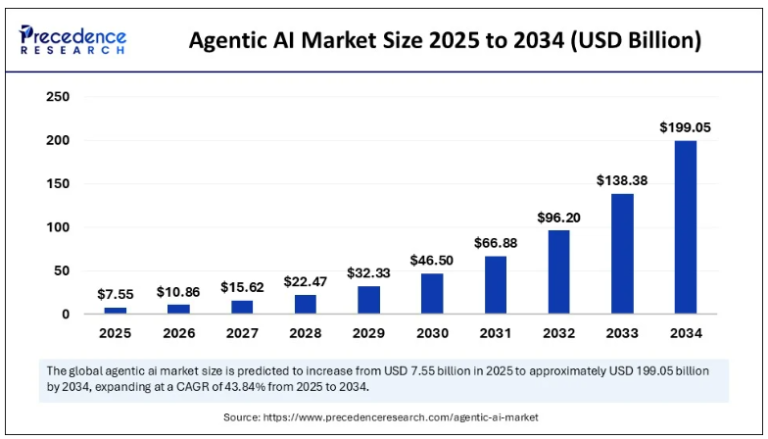
The traditional PoC model, which relies on isolated applications, is no longer sufficient. Future management must pivot from “process control” toward “goal setting and cybersecurity governance,” building systemic capabilities that can operate sustainably in the long term.

The Entry Ticket: No Domain Knowledge, No Reliable AI

The core reason most AI Agent projects fail is not a lack of model capability, but a lack of Domain Knowledge. In manufacturing, for instance, critical expertise is often held by veteran masters and remains unrecorded. This makes it difficult for AI to understand or apply these “hidden” insights.

Research from The future of AI for the insurance industry | McKinsey suggests that companies capable of integrating proprietary data into AI systems have a 25% higher profit potential than their peers. This proves that a true competitive edge stems from internal corporate know-how.

Take Profet AI’s Domain Twin as an example. The core concept is to transform the decision-making logic and historical data of veteran experts into iterative digital assets. By embedding these into corporate workflows, businesses can bridge the domain knowledge gap, enhancing the accuracy, consistency, and traceability of decisions.

From “Capable” to “Confident”: Cybersecurity as the Deciding Factor

As AI Agents move beyond generating suggestions to accessing systems and executing critical tasks, the nature of risk changes. Consequently, cybersecurity governance is becoming the top priority for enterprises evaluating AI solutions.

“Digital Employees” also need a probation period! 

Imagine a “digital employee” hired to process orders and customer emails at high speed:

  • The Unmonitored Black Box: If this employee holds a “master key” (unrestricted access), a single email containing malicious instructions (a Prompt Injection attack) could trick the AI into prioritizing a fake task. Without auditing, this “intern” might use high privileges to connect to external servers and leak trade secrets before the company even notices.
  • Zero Trust Architecture (Controlled Behavior): In a Zero Trust framework, an Agent must undergo “continuous verification.” Every time it attempts to read a file or transfer data, the system verifies its identity and the legitimacy of its behavior in real-time. If the intern attempts to exceed their authority and connect to an abnormal domain, the system detects the deviation immediately.

The Cloud Security Alliance (CSA) emphasizes in its《Agentic Trust Framework》that AI systems must be built on Zero Trust principles: “Never assume trust for any Agent, regardless of its power; continuous identity and behavioral verification are mandatory.” AI Agents should be treated like human employees—access should not be granted all at once but earned through performance and trust.

The Future Factory: Not Just Automation, but “AI Collaboration”

As Agentic AI matures, the core logic of business operations is shifting. True differentiation will come from the synergy between multiple AI Agents. However, these benefits must be built on a robust architecture; otherwise, fragmented AI behaviors may actually amplify risk.

To help enterprises move from “capable” to “confident,” Profet AI and Zentera Systems have developed a Layered Defense Architecture, integrating the “AI Brain” with a “Security Moat”:

  1. Application Layer – The Knowledge Brain (Profet AI): Through our Domain Twin™ platform and the enterprise-grade agent collaboration environment, AI Studio, we help manufacturers digitize veteran expertise into AI Agents with deep domain knowledge.
  2. Network & Compute Layer – The Zero Trust Moat (Zentera Ensage AI): When an AI Agent communicates with internal databases or external LLMs, Zentera provides real-time behavioral control across three dimensions: inbound, internal, and outbound. Crucially, this mechanism requires no changes to existing IT/OT infrastructure. It can be deployed on-premise or in hybrid environments, perfectly meeting manufacturing requirements for low latency, data sovereignty, and operational resilience.

In this framework, AI is no longer a source of potential risk but a managed and trusted corporate asset. Ultimately, the key to future competition will not be who adopts AI first, but who can make AI stable, controllable, and consistently value-creating.

From “Interesting” to “Useful”: Why Enterprises are Skipping GenAI PoCs in 2026 Read More »

,

Zentera Systems and Profet AI Partner to Deliver Zero Trust Security for Agentic AI in Manufacturing​

Zentera Systems and Profet AI Partner to Deliver Zero Trust Security for Agentic AI in Manufacturing

Partnership pairs Profet AI's trusted Domain Twin™ platform with Zentera's Ensage™ AI to protect AI agents operating in sensitive production environments

Zentera Systems and Profet AI today announced a go-to-market partnership to secure agentic AI deployments in manufacturing environments. Under the partnership, Zentera’s Ensage AI platform will provide Zero Trust security in the compute and network layers for Profet AI’s Domain Twin™ platform, which is used by more than 300 manufacturers across the semiconductor, electronics, PCB, EMS, and advanced materials industries. The companies will demonstrate the integrated solution at RSA Conference 2026, North Hall, Booth #4618, March 23–26.

Profet AI has established itself as Asia-Pacific’s leading no-code AutoML software for manufacturing. Its Domain Twin™ platform enables manufacturers to digitize the tacit expertise of veteran engineers – process tuning, quality assessment, parameter optimization – into reusable AI models that can be replicated across production lines, factories, and global operations. Customers include major brands in the EMS, semiconductor OSAT, IC design, display panel, and materials sectors. As Profet AI expands its platform’s agentic AI capabilities through AI Studio, its enterprise-grade agent collaboration environment, securing the connections between AI agents, production data, and enterprise resources has become a critical priority.

“AI agents can deliver tremendous value in manufacturing, but security cannot be an afterthought,” said Jerry Huang, CEO of Profet AI,  “Our customers trust Domain Twin with their most valuable competitive asset — decades of accumulated production expertise. Partnering with Zentera gives us infrastructure-level Zero Trust protection that ensures this knowledge stays secure as our platform’s agentic capabilities scale.”

Closing the Security Gap for Manufacturing AI Agents

As manufacturers deploy AI agents across production systems, predictive maintenance platforms, and data analytics workflows, these agents create new machine-to-machine paths between AI runtimes, databases, MCP servers, and external LLMs. Traditional security tools lack visibility into these connections and cannot enforce granular access controls at the computing and infrastructure level.

Ensage AI extends Zentera’s Zero Trust Architecture to address security blind spots created by agentic AI — including unauthorized access, shadow AI, privilege escalation, IP spoofing, man-in-the-middle attacks, and uncontrolled data movement between AI systems and enterprise resources in the enterprise compute and network environments.

“Profet AI is solving one of manufacturing’s most critical challenges — preserving and scaling the irreplaceable expertise that drives competitive advantage,” said Dr. Jaushin Lee, CEO of Zentera Systems. “As that knowledge becomes embedded in AI agents that actively interact with production systems, securing those agent pathways at the network layer is essential. This partnership ensures manufacturers can scale agentic AI while meeting corporate governance, risk, and compliance requirements with confidence.”

Infrastructure-Level Zero Trust for Agentic AI

Ensage AI monitors and controls agentic behavior across three enforcement planes:

  • Inbound Controls – Authenticate and authorize who can access and operate AI runtimes
  • Outbound Controls – Govern which LLMs, tools, and domains agents can reach
  • Internal Controls – Restrict agent access to sensitive enterprise and operational resources

The platform provides complete visibility into agent-to-resource traffic, enforces policy-based access controls, prevents unauthorized data leaks, and creates audit trails from the network layer for compliance and governance. Unlike cloud-routed SASE models, Ensage AI operates on-premises or in hybrid environments – critical for manufacturing and industrial operations where latency, data sovereignty, and operational resilience are paramount.

Live Demonstration at RSA Conference

At RSA Conference 2026, the companies will demonstrate Ensage AI protecting Profet AI’s agentic platform in a live workflow scenario. The demonstration will showcase how Zero Trust Architecture secures MCP queries, agent-to-resource communications, and access to sensitive manufacturing data — all while maintaining the performance and flexibility AI applications require.

RSA Conference attendees are invited to visit Booth #N4618 to see the demonstration and discuss secure agentic AI deployment strategies with engineers from both companies.

About Zentera

Zentera Systems is the Zero Trust security company that protects what moves across enterprise networks – whether it is a user, a workload, or an AI agent. The company’s solutions deploy as an overlay on top of any infrastructure – IT, OT, cloud, or hybrid – to enforce Zero Trust security without re-architecting the network. With the launch of Ensage AI, Zentera now extends this same foundation to secure the autonomous AI agents operating inside enterprise environments. Zentera is headquartered in Silicon Valley and trusted by Global 2000 enterprises across semiconductor, financial services, healthcare, and public sector.

About Profet AI

Profet AI is a Taiwan-headquartered AI software company focused on manufacturing. Its Domain Twin™ platform—powered by AutoML (Machine Learning), AI Studio (Agentic AI), and AILM (AI governance and lifecycle management), helps enterprises preserve, scale, and replicate frontline know-how as an enterprise AI brain where knowledge never retires.

Serving over 300 manufacturers across Asia across industries such as electronics, semiconductors, PCB, IC design, display panels, and advanced materials, Profet AI enables smarter, more scalable, asset-light operations from a single production line to multi-plant, cross-border manufacturing.

Zentera, Ensage, and CoIP are trademarks of Zentera Systems, Inc., in the United States and other countries. All other trademarks cited here are the properties of their respective owners.

Contact Us to Learn More

Zentera Systems and Profet AI Partner to Deliver Zero Trust Security for Agentic AI in Manufacturing​ Read More »

,