
How Can Engineering Expertise Keep Pace with Business Growth?Crossover Talks Taichung Explores AI and Supply Chain Competitiveness
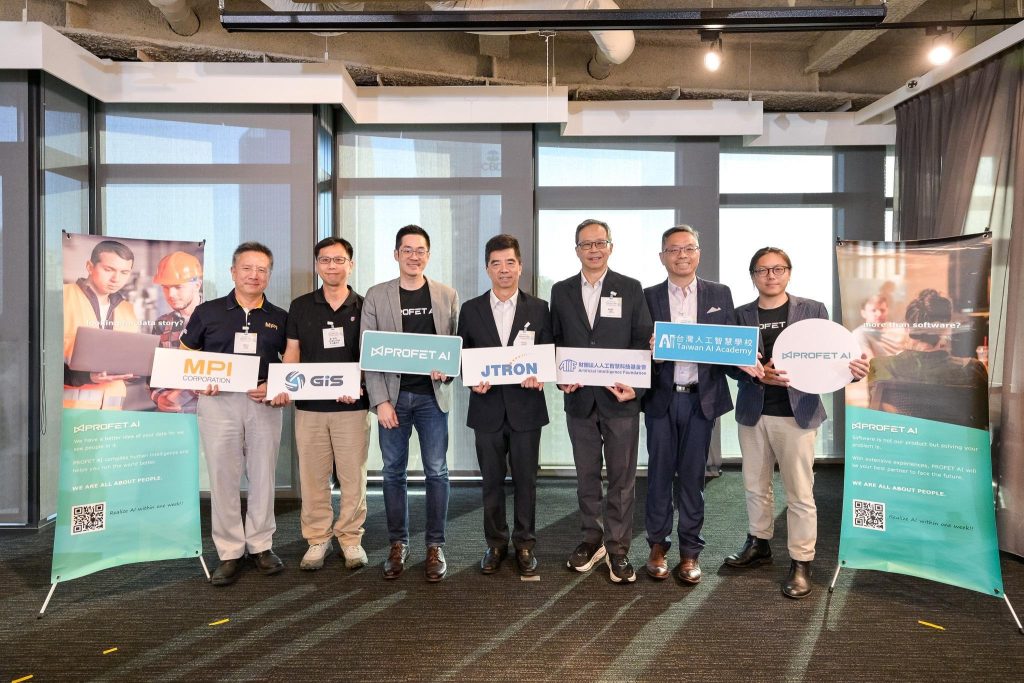
From left: 孫宏川, R&D Director, MPI Corporation; 劉立偉, Department Manager, Information Technology Division, General Interface Solution Limited; Jonathan Yu, General Manager of Global Sales, Profet AI; 林益民, Chairman, Jtron Technology Corp.; 謝禮宗, Industry Advisor, Artificial Intelligence Foundation; Benjamin Kuo, Vice President for Industry-Academia Collaboration, Taiwan AI Academy; and DC Tsai, Senior Technical Manager, Profet AI.
As manufacturers continue to expand their facilities and enter overseas markets, demand for equipment delivery, troubleshooting, and training for new employees grows with them. Investment can increase equipment capacity and production output, but the judgment that experienced engineers have developed over many years is difficult to replicate at the same pace. When critical issues still have to wait for a handful of people to resolve them, engineering services can become a bottleneck to business growth.
On October 21, Profet AI hosted “2026 Crossover Talks Taichung: Experience as Production Capacity · FAE Twin,” bringing together representatives from Jtron Technology Corp., MPI Corporation, General Interface Solution Limited of GIS Group, the Artificial Intelligence Foundation, and Taiwan AI Academy. Focusing on intelligent equipment, the transfer of engineering knowledge, and enterprise AI applications, participants discussed how manufacturers can enable more teams to draw on existing expertise while expanding service capacity, maintaining delivery quality, and preserving customer trust.
From Replicating Engineering Expertise to Offering Equipment Services: Using AI to Support Business Growth
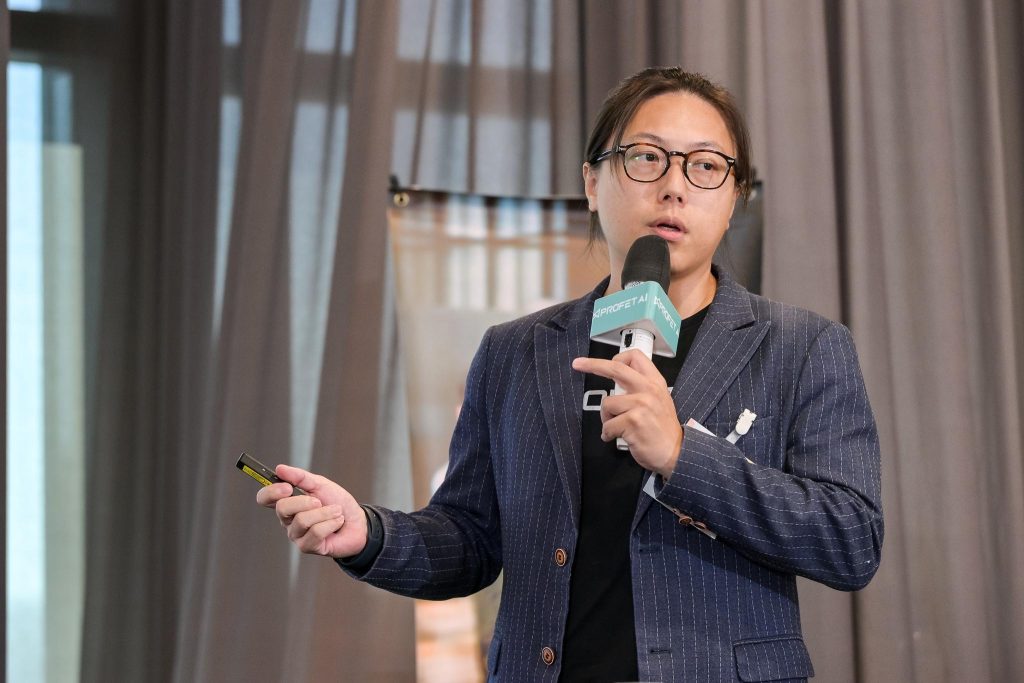
DC Tsai, Senior Technical Manager at Profet AI, shares practical FAE Twin use cases.
For equipment suppliers, selling more equipment also means greater demand for after-sales service. When a customer reports an issue, engineers need to identify the equipment model and determine whether the production line has stopped, then look for clues in equipment records, manuals, standard operating procedures (SOPs), and past cases. Experienced engineers know what to check first. Newer engineers, however, may move repeatedly between searching for information, verifying it, and asking colleagues for help, slowing down service.
Using FAE Twin as an example, DC Tsai, Senior Technical Manager at Profet AI, explained how Domain Twin™ can organize experienced engineers’ troubleshooting logic into reusable AI Skills, enabling agents to help retrieve information, perform preliminary diagnoses, and troubleshoot issues. For example, whether equipment has caused a production line to stop affects the order in which issues should be addressed, while different models require different diagnostic approaches. By making these conditions and steps explicit, engineers with different levels of experience can draw on a shared body of knowledge and methods to resolve problems, reducing the time spent repeatedly searching for information.
When engineering knowledge and data analysis become an ongoing part of service workflows, they also create new business opportunities for equipment suppliers. Clean Air as a Service (CaaS), a collaboration between Profet AI and Yesiang Enterprise Co., Ltd., extends the business from selling filters to providing clean air management services that combine environmental monitoring and analysis. Another collaboration, with an international automated test equipment provider, packages equipment data analysis as an add-on service. These approaches enable equipment suppliers to continue helping customers manage issues during equipment use, extending their services beyond the products themselves.
The Last Mile of Automation: Giving Equipment the Ability to Make Decisions
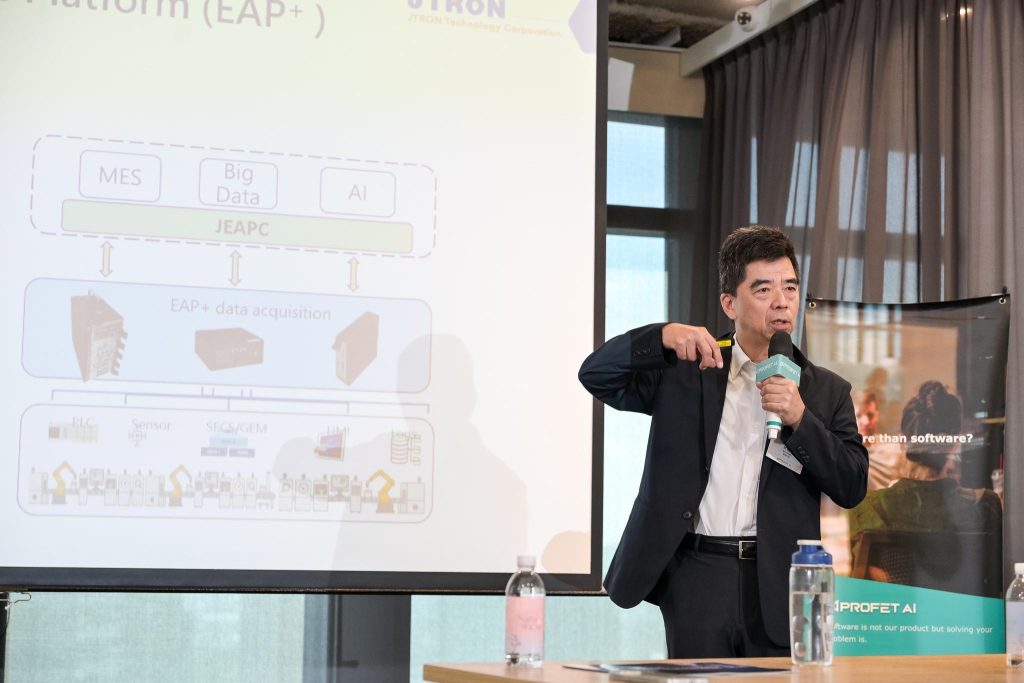
林益民, Chairman of Jtron Technology, shares approaches to handling equipment issues and transferring engineering expertise.
林益民, Chairman of Jtron Technology, once visited an unmanned factory where automated material-handling equipment continued operating with the lights off, yet engineers were still making repairs while wearing headlamps. Equipment can operate automatically, but when anomalies, parameter drift, or unexpected downtime occur, decisions and responses still depend on human experience. Without connecting data, diagnostics, and response workflows, adding more automated equipment can also create a greater maintenance burden.
“You can poach my people, but you cannot take my know-how or the intelligence built into my systems!”
This is the goal 林益民 hopes to achieve: retaining engineering knowledge and procedures in systems so that new engineers can access the reasoning behind experienced colleagues’ decisions when problems arise. For this knowledge to be useful, however, equipment data must first be accessible, and analytical results must connect to on-site response workflows.
Through Equipment Agent, edge computing, and integrated equipment communications, Jtron Technology enables equipment from different generations to collect data, analyze it in real time, and take appropriate action. Some issues cannot wait for a central system to respond and require decisions and action on site. Knowledge transfer, data acquisition, and equipment control therefore need to be considered together to apply engineering expertise to troubleshooting and predictive maintenance.
Turning Experienced Engineers’ Knowledge into an Asset for the Entire Team
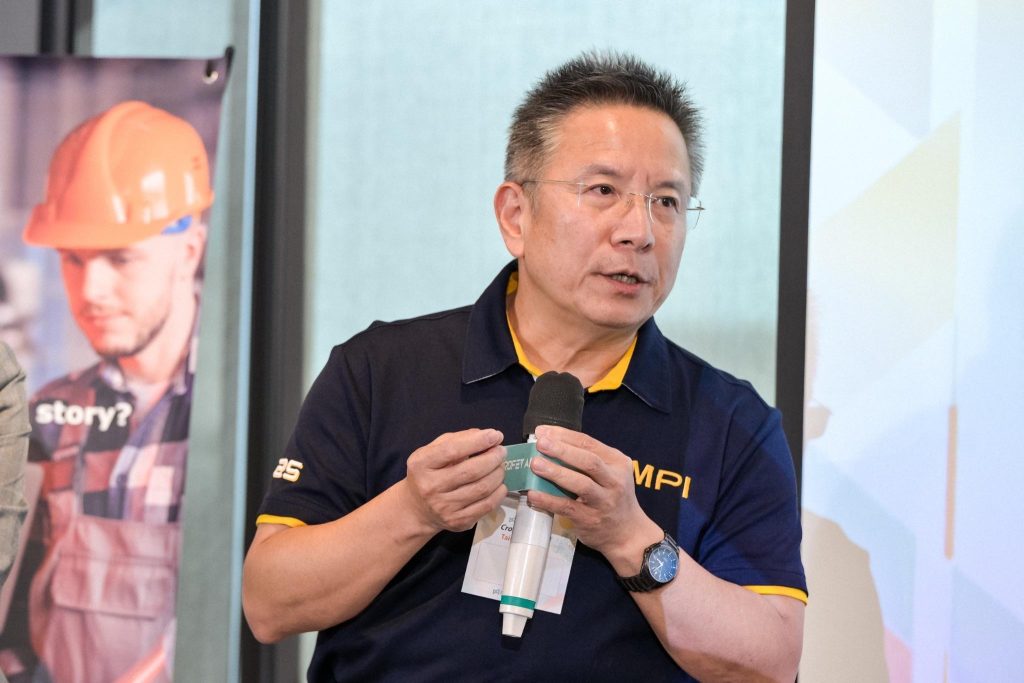
孫宏川, R&D Director at MPI Corporation, shares approaches to promoting knowledge transfer and internal exchange.
As R&D teams grow, many companies face the challenge of maintaining consistent work quality among engineers with different levels of experience. The team previously developed computer-aided design, testing, and engineering tools to help colleagues work more efficiently. As the number of tools increased, however, maintenance, upgrades, and integration also became a burden. MPI has therefore gradually focused its resources on its R&D expertise while working with technology partners on platform and system integration.
Beyond tools, experienced colleagues’ judgment also needs to be documented and shared. 孫宏川, R&D Director at MPI Corporation, suggested drawing on the concept of citations in patents and academic papers: when knowledge or an agent is used, the contributor’s input can be recorded and recognized. Regular workshops, exchanges of project results, and project tracking can complement this approach, giving colleagues opportunities to understand how other teams work.
“As long as our methods, formats, and mechanisms for exchange are consistent, these individual pieces of knowledge can be referenced by others and built upon over time, eventually becoming capabilities of the company itself.” Using common methods and formats from initial concept through project completion makes it easier for colleagues to build on one another’s work. To meet the service needs of global customers, 孫宏川 also hopes to further integrate product designs, usage histories, and incident records. This would give frontline engineers access to the information behind expert decisions even when senior specialists are not nearby, allowing them to apply their own expertise in responding to customers.
From Requirements to User Feedback: Bringing AI into Workflows
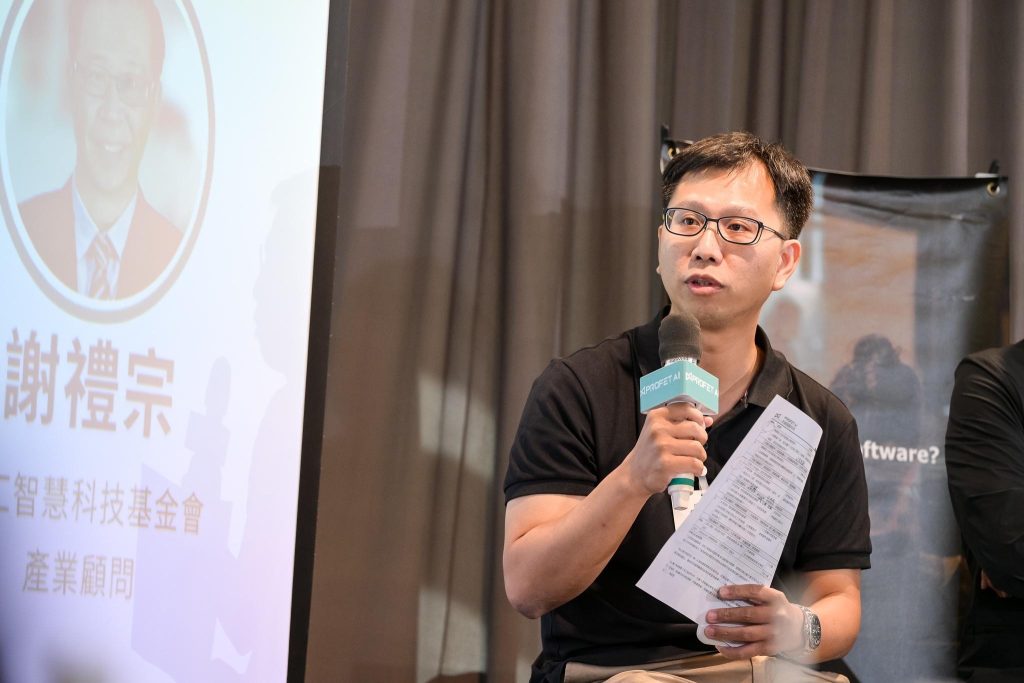
劉立偉, Department Manager in the Information Technology Division at General Interface Solution Limited, shares experience in consolidating requirements and advancing AI adoption.
As customers expect more visibility into production progress, quality traceability, and real-time information, IT departments need a deeper understanding of business and manufacturing workflows. A single customer requirement may involve process engineering, production, quality assurance, and other functions. Building systems solely around requests from individual departments may still fail to answer the questions that actually matter to the customer.
劉立偉, Department Manager in the Information Technology Division at General Interface Solution Limited, explained that IT teams first need to clarify requirements, data sources, and responsibilities. Internal users or customers then need to confirm whether the data is accurate and answers their questions, providing a basis for developing systems and advancing automation step by step. Knowledge management presents similar challenges. Document control centers have accumulated technical documents and customer service information, but while experienced colleagues know where to find the files, newer employees may not. AI can help organize, connect, and search this information, while data sources, versions, and conditions of use still require ongoing maintenance.
“We want people to use AI, rather than be led by AI tools.”
Before implementation, companies should review the complete workflow and break down the information, decisions, and actions required at each step. After launch, they should observe which functions people use and which fall short of expectations, then make adjustments based on feedback. When AI fits the way colleagues work, existing data can be put to practical use in cross-departmental collaboration and customer service, and system development can support subsequent operational improvements.
Customer Trust Comes from the Ability to Deliver Consistently at Scale
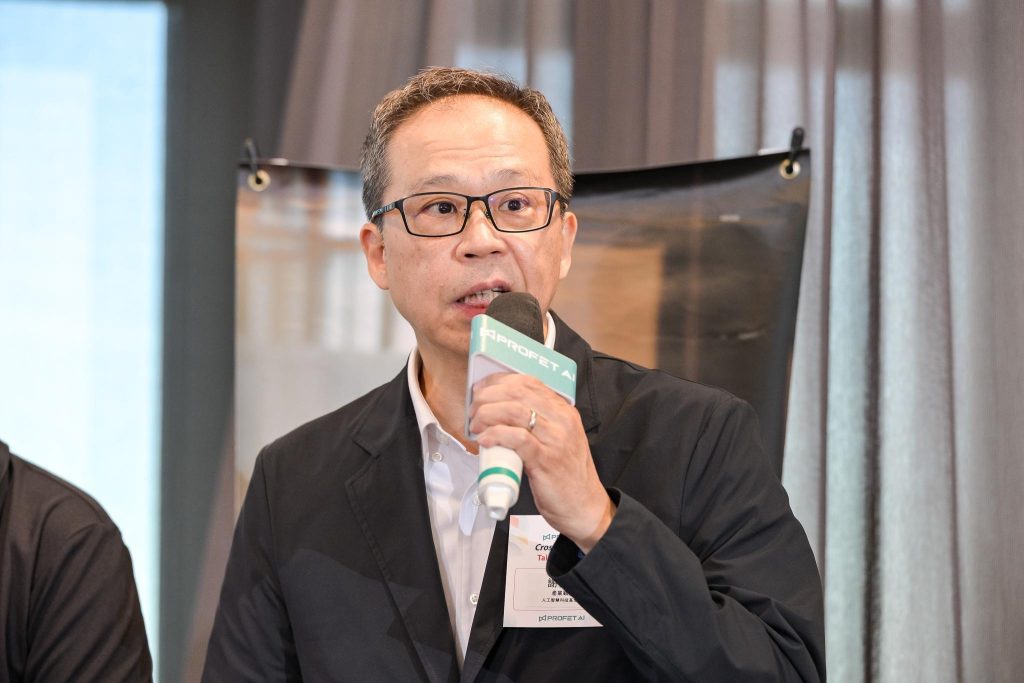
謝禮宗, Industry Advisor at the Artificial Intelligence Foundation, shares key considerations for transferring knowledge within an enterprise.
Technology and quality are important requirements for entering a supply chain. Long-term partnerships, however, depend on a supplier’s ability to keep solving problems, deliver consistently, and adapt to customer needs. Starting from the perspective of customer trust, 謝禮宗, Industry Advisor at the Artificial Intelligence Foundation, noted that this requires coordination across R&D, manufacturing, quality, production management, and information systems. It is difficult to achieve through the efforts of a few engineering experts alone.
As services expand across teams and facilities, companies also need to sustain this ability to deliver. Deploying AI across plants is one test of that capability. A model or agent that works on one piece of equipment may need adjustment on another production line because of differences in people, equipment, materials, and operating methods.
謝禮宗 noted, “Combining software with methodology gives us a better way to preserve, replicate, and continually update the know-how of different experts.” Expert interviews, process reviews, and comparisons of the conditions under which different approaches apply should therefore begin during requirements discussions, data preparation, and proof of concept. Recording the reasoning behind decisions and the validation results, then maintaining that knowledge after deployment, helps other teams understand which experience can be reused and what needs to be checked again. Replication across plants requires bringing effective methods into new environments and confirming that, after adjustment, they still deliver the quality customers expect.
Preserving Experienced Practitioners’ Judgment: Make It Explicit, Structure It, and Put It into Practice
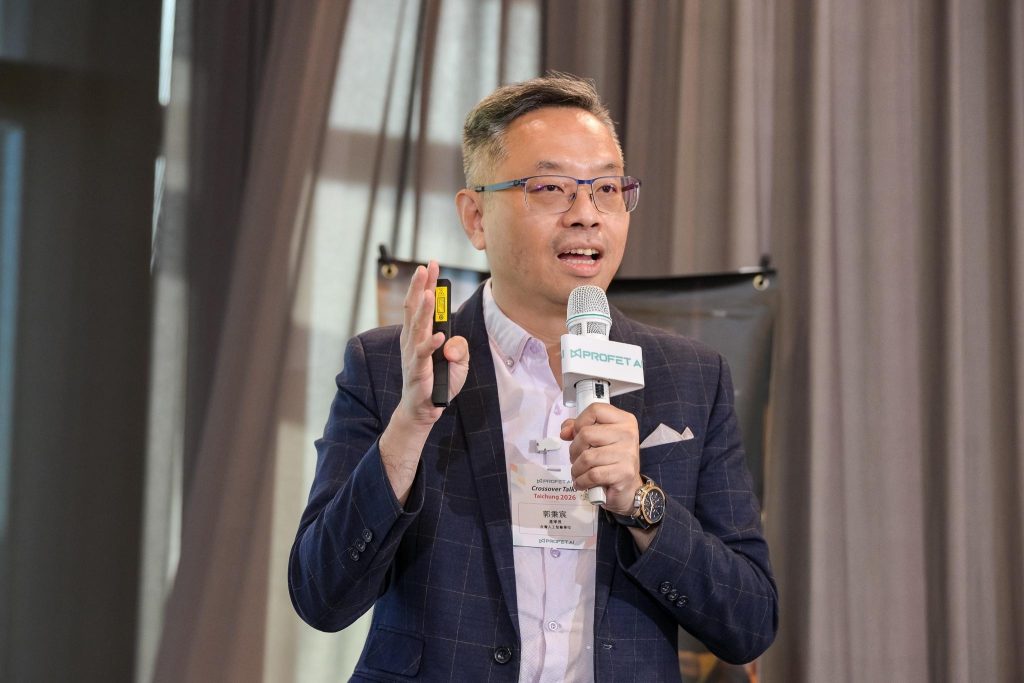
Benjamin Kuo, Vice President for Industry-Academia Collaboration at Taiwan AI Academy, shares three steps for turning expert experience into organizational capabilities.
As companies expand overseas, they can add equipment and production lines, but their most experienced practitioners cannot be at every facility at once. Benjamin Kuo, Vice President for Industry-Academia Collaboration at Taiwan AI Academy, observed that experienced staff can detect problems through subtle changes in sound, temperature, and other signals, yet often explain their judgment simply by saying, “You know after doing it for long enough.” This judgment, which is difficult to pass on fully through SOPs, represents the expertise companies have accumulated over many years.
“Where is the most intelligent AI? It is actually in the experienced practitioners on the factory floor.”
When critical issues still have to wait for a handful of people to resolve them, engineering expertise can limit the scale of a company’s services. To help more people learn and apply this experience, Benjamin Kuo proposed three steps:
- Make experience explicit: Use interviews to clarify the signals experienced practitioners observe and the reasoning behind their decisions, then compare these with equipment data and response procedures.
- Structure the logic: Organize the relationships between signals and anomalies, along with the conditions under which different approaches apply. Have experienced practitioners review the results to eliminate assumptions that appear reasonable but do not apply.
- Put decisions into practice: Have IT and AI teams incorporate decision criteria and response procedures into systems that colleagues can use in their daily work, with ongoing validation and updates.
Companies can begin with activities that rely heavily on experienced staff, such as after-sales service, new product introduction, or root cause analysis, and use small-scale validation and measurable results to decide how to expand adoption. Manufacturing operations demand high reliability. Implementation therefore also requires clearly defined permissions, responsibilities, and audit mechanisms, with domain experts continually validating the knowledge to determine which recommendations can be adopted and which actions require human confirmation.
Has AI Become Part of Your Company’s Critical Work?
Can engineering services keep pace with business growth? Can data be used across departments? Can different facilities draw on existing experience? These are all questions companies need to answer when assessing AI outcomes. Panel moderator Jonathan Yu, General Manager of Global Sales at Profet AI, noted, “The real difference may lie in whether AI is simply being used to improve individual productivity or has become part of critical business processes and ongoing operational improvement.”
This requires domain experts, IT teams, and business units to work together, applying engineering knowledge in R&D, manufacturing, and customer service while continually reviewing results and making adjustments. Through Domain Twin™, Profet AI also aims to turn experience dispersed across people, equipment, and systems into knowledge that companies can manage, trace, and reuse. When new employees join, new customers bring requirements, or overseas facilities begin operating, teams can continue drawing on the expertise they have accumulated to solve problems.
To learn more about organizing and passing on the knowledge and experience of your seasoned practitioners so that more colleagues can apply it in their work, please complete the form below to get in touch with us.