
Enterprise AI Agent Operations Platform
Domain Twin™
Turn enterprise expertise into AI that can predict and act.
Bring manufacturing know-how, enterprise data, ML predictions, and agentic AI into one operating platform, so AI can move from understanding a problem to working through a controlled process.
Keep expertise in the enterprise, and keep knowledge at work.
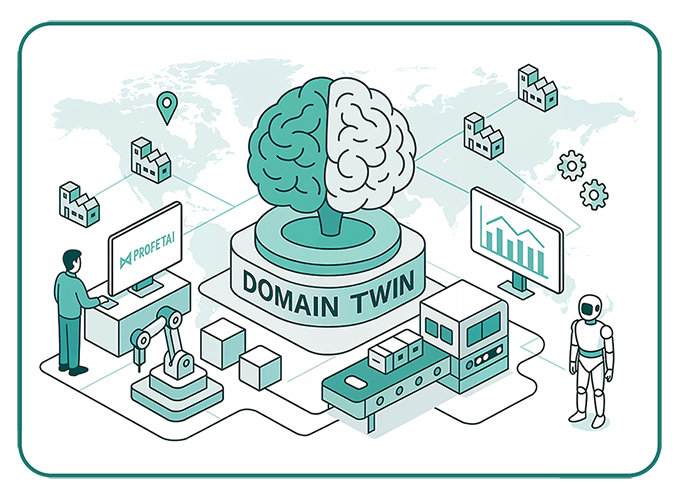
Why Domain Twin
Enterprise AI needs operating context, not another standalone tool.
Models, agents, and knowledge bases can be built quickly. The hard part is enabling them to understand business context, use the right evidence, and keep working within clear accountability boundaries.
Expertise is fragmented
Process conditions, equipment know-how, and anomaly judgments remain scattered across people, documents, and isolated systems, making proven practices difficult to replicate.
Predictions are disconnected from workflows
ML can produce results, but those predictions do not automatically become shop-floor decisions, follow-up actions, or continuous improvement.
Agents lack clear guardrails
When data access, tool permissions, write-back scope, and accountability are unclear, agents cannot safely become part of enterprise operations.
Platform capabilities
From evidence-backed prediction to controlled action.
Enterprises need more than models or agents. They need AI capabilities that turn operational data into verifiable decisions, enter workflows under explicit authorization, and feed results back for continuous improvement.
ML Intelligence
Build prediction, optimization, and anomaly-detection models from process, equipment, quality, and operations data, while preserving data conditions, model versions, and explainability evidence.
Agentic AI
Combine enterprise knowledge, ML outputs, Skills, and Workflows into role-based AI Staff that coordinate tools and complete multi-step work within role permissions.
Security & Governance
Across data, models, agents, Skills, and system write-back, every access and action is governed by policies, permissions, accountable owners, and audit records.
How it works
One decision path connects manufacturing know-how, ML, and agents.
ML predicts and optimizes. Agentic AI interprets context, coordinates work, and acts. Keeping these roles distinct separates generated content from verifiable model outputs.
Operational views
Make AI decisions and actions transparent to operators.
Bring data, models, domain knowledge, and governance conditions into one decision context. Each view answers a question enterprise teams actually need to verify.
Predictions need evidence you can revisit.
A risk score is not enough. Teams need to see how data conditions, model versions, and expert rules contributed to the decision.
- 01Capture operating contextBring equipment signals and process conditions into the same use-case definition.
- 02Generate a model assessmentThe model identifies anomaly risk and returns explainable contributing factors.
- 03Preserve verification evidenceData scope, model version, and usage constraints remain traceable.
Models operate only within approved data scope. High-risk decisions still move forward according to role permissions and human review.
Enterprise Architecture
Put enterprise context, AI capabilities,and existing systems intoone architecture.
Domain Twin does not replace ERP, MES, PLM, or OT systems. It connects data, knowledge, predictions, and workflows so AI can be built, used, monitored, and improved within enterprise boundaries.
Define the operating context AI must understand using your own enterprise data, manufacturing conditions, and expert rules.
Connect existing enterprise systems, factory environments, and knowledge sources without replacing ERP, MES, PLM, or OT.
In one operating layer, predictions are evidence-backed, agents stay within authorized boundaries, and every use and action can be reviewed.
Bring validated decisions into daily collaboration, role-based tasks, and cross-system workflows instead of leaving AI in a standalone chat interface.
Security & Governance by Design
Give every AI access, decision, and action a clear boundary.
Governance needs to answer three questions: what AI can access, what it can do, and whether an issue can be traced. Zero Trust governs identity and resource access; AI Governance manages the lifecycle of data, models, agents, and workflows.
CONTROL
Define what an agent may query, recommend, execute, and write back. High-risk actions require human confirmation according to policy.
GOVERN
Data, models, agents, Skills, permissions, and versions each have an owner, lifecycle, and continuous monitoring.
AUDIT
Preserve inputs, cited evidence, model versions, tool use, approvals, and execution results so accountability and improvement remain traceable.
Zero Trust principles
Do not assume trust based on network location or an existing session. Every resource access is explicitly verified and authorized based on identity, context, and policy.
SEMI E187 alignment
For semiconductor equipment connectivity, the architecture can be mapped to equipment-security baselines such as operating system support, network security, endpoint protection, and security monitoring.
This describes the governance and security design direction only. It does not indicate that the product or any customer environment has been verified or certified for SEMI E187 compliance.
Business impact
Make expertise replicable and reliable across operating environments.
What enterprises need to scale is not just agents, but validated decision methods, models, workflows, and governance rules.
Replicate expertise across operations
- Preserve critical manufacturing know-how and reduce knowledge loss from workforce turnover
- Reuse models, SOPs, and decision processes across plants and functions
- Maintain decision quality with consistent data, versioning, and governance
Localize with control
- Adapt domain context by production line, equipment, language, and operating conditions
- Reduce the time new plants and teams need to build knowledge and decision capability
- Set how AI recommends, seeks approval, and executes based on risk and accountability boundaries
Adoption path
Start with one verifiable use case, then scale with governance.
Don’t start by building dozens of agents. Put one use case into production, then reuse the verifiable, governable method across more operations.
Phase 1 | Define and validate
Exit criteria: verifiable results and real user adoptionStart with a manufacturing problem that has a clear owner, such as equipment anomaly prediction, quality root-cause analysis, or SOP knowledge retrieval.
- Start withConfirm the target, baseline, available data, expert rules, and user roles
- How to validateValidate prediction or workflow results with real data, while preserving human review and adoption feedback
- What you leave withA reusable use-case definition, data conditions, and model or knowledge versions
Twin Accelerator
Apply shared platform capabilities to specific manufacturing and business workflows.
Three Twins address three operating environments: new product introduction, equipment support, and production management, all built on the same verifiable, governable operating method.
NPI Twin™
Connect specifications, trial production, quality, and cross-functional collaboration so NPI decisions have context and progress stays traceable.
Learn MoreFAE Twin™
Turn equipment service cases, technical knowledge, and engineering judgment into traceable, governable AI capabilities for technical service.
Learn MorePMC Twin™
Bring capacity, scheduling, quality, and shop-floor status together so production management stays predictable and coordinated as conditions change.
Learn MoreStart with one real problem
Discuss a real use case and define a path to production.
Tell us which prediction, decision, workflow, or knowledge gap you want to improve. We can help determine whether to start with ML, agentic AI, governance architecture, or a specific Twin use case.