Profet AI Brings Domain Twin Co-Lab to Tunghai University
Advancing Enterprise-Grade AI Agent Governance in Campus AI Education and Real-World Practice
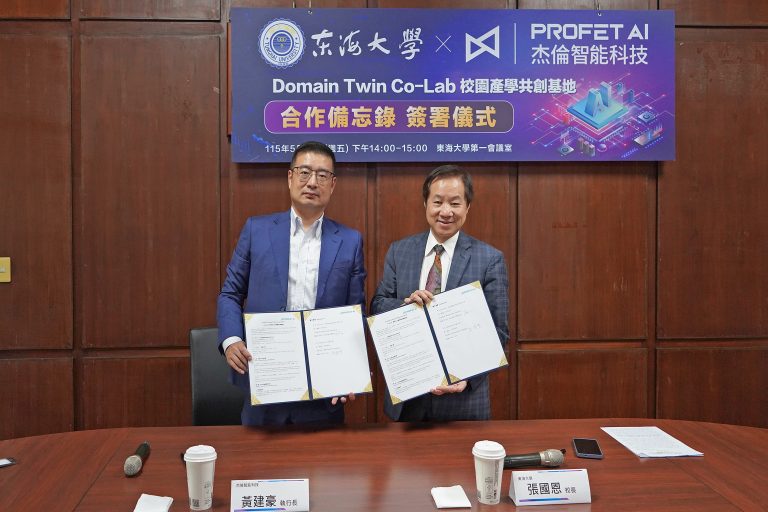
Profet AI today signed a Memorandum of Understanding (MOU) with Tunghai University, bringing the Profet AI Domain Twin Co-Lab campus industry-academia co-creation program to Tunghai University. Under the MOU, Profet AI will provide its Domain Twin™ platform as a key resource to support the university’s AI education, non-commercial research, and industry-academia collaboration.
The collaboration will connect with Tunghai University’s existing OpenClaw practice environment and introduce enterprise-grade AI Agent governance capabilities through Profet AI Domain Twin. Centered on teaching, research, hands-on exploration, and industry-academia engagement, the partnership aims to help students understand the security, management, governance, and human-AI collaboration capabilities required as Agentic AI moves from standalone tools into real campus and enterprise deployment.
Tunghai University has actively advanced AI education and campus innovation in recent years. The university has built Taiwan’s most powerful campus AI Pod computing center and the largest OpenClaw “lobster pool” environment, while continuing to promote its innovative “Students as Teachers” educational philosophy. These efforts enable students, faculty, and administrative teams to more quickly engage with AI practice scenarios. With Profet AI Domain Twin Co-Lab entering Tunghai University’s AI education framework, the collaboration will further address the critical link that enables agentic AI to move from “usable and executable” toward being “controllable, manageable, and auditable.” This will allow students not only to learn how to operate AI tools, but also to understand the governance and deployment challenges AI Agents face when entering real organizational workflows.
From Passive Query to Proactive Service: Building an Enterprise-Grade AI Agent Practice Environment
As Agentic AI rapidly enters education, administration, and research scenarios, AI Agents are no longer only tools for answering questions. They are beginning to understand workflows, call systems, generate documents, and assist with task execution. However, as AI Agents enter real organizational workflows, the challenge facing schools and enterprises is also shifting from “whether AI can be used” to “whether AI can be managed, audited, tracked, and trusted.”
Under this framework, Tunghai University’s existing AI Pod computing center and OpenClaw practice environment provide students with a hands-on foundation for engaging with agentic AI. Profet AI Domain Twin further brings in enterprise-grade AI governance thinking, helping bring distributed AI Agent tools into a framework that is manageable, traceable, and auditable. This allows AI Agents to evolve from standalone automation tools into digital service and governance capabilities that are closer to real industry practice.
Domain Twin Co-Lab Cultivates Not Only AI Users, but a New Generation of Talent Capable of Designing, Managing, and Governing AI
Profet AI has long focused on AI implementation in manufacturing. With Domain Twin™ at its core, Profet AI helps enterprises transform process experience, domain knowledge, and operational know-how into AI assets that can be preserved, governed, and replicated. By bringing Domain Twin Co-Lab to Tunghai University, Profet AI is extending its enterprise-grade AI implementation experience into the campus environment, enabling students to learn AI tools while also understanding the workflow design, permission governance, data security, and human-in-the-loop review mechanisms required when AI Agents enter real organizational processes.
“The value of AI Agents lies not only in whether they can automatically execute tasks, but more importantly in whether organizations can clearly understand what they did, what they accessed, where their permissions came from, and whether actions can be traced and controlled when issues occur.” sadi Jerry Huang, CEO and Co-founder of Profet AI, “Without governance mechanisms, AI Agents may create new forms of shadow AI and cybersecurity risk. But when managed through a unified control plane, they have the potential to become an important foundation for enterprise knowledge accumulation, workflow automation, and cross-domain collaboration. Profet AI has long focused on AI implementation in manufacturing, and we understand that what enterprises truly need is not just smarter tools, but an architecture that allows AI to enter operational workflows while remaining securely governed. We are pleased to collaborate with Tunghai University through Domain Twin Co-Lab to help students connect with the practical standards required for future enterprise AI Agent deployment, and to cultivate a new generation of AI talent with strong awareness of security governance and practical industry capabilities.”
Kuo-En Chang, President of Tunghai University, mentioned that Tunghai has been actively building an advanced computing environment and promoting its innovative “Students as Teachers” educational philosophy. He expressed appreciation for Profet AI’s provision of advanced software resources. Built upon Tunghai’s robust hardware foundation and OpenClaw practice environment, this collaboration will strengthen the university’s AI governance framework, guide students in real-world practice scenarios, and deepen their understanding of the human-AI collaboration mindset and technological literacy required for enterprise deployment, further improving the efficiency of university administration and teaching.
Chao-Tung Yang, Chief Information Officer of Tunghai University, added that this collaboration brings Profet AI’s technology foundation into the university’s AI Pod computing center. Through the powerful computing capabilities enabled by NVIDIA B200 chips, combined with the workflow governance mechanisms introduced by Domain Twin Co-Lab, Tunghai University will establish a leading practice environment that brings together both “AI computing power” and “AI governance.” This will help students move beyond learning standalone tools and toward hands-on creation within enterprise-grade governance architectures, cultivating the decision-making and innovation capabilities essential in the AI era.