INDUSTRIAL AI · TECHNICAL ARCHITECTURE
A technical architecture for connecting NVIDIA-enabled physical-world intelligence with manufacturer-specific expertise, Machine Learning, Agentic AI, governance and action
Industrial digital twins model physical state and possible outcomes. Profet AI Domain Twin™ adds manufacturing knowledge, model evidence, permissions and workflows so teams can turn that evidence into governed action and reusable operating expertise.
In this article
ARCHITECTURE PREMISE
In this architecture, the industrial digital twin provides a computable model of the physical operating environment. Domain Twin™ makes the manufacturer-specific knowledge, model evidence, decision rights and governance around that environment machine-operable.
Manufacturers have spent years building digital representations of factories, production lines, machines and products. That work is now converging with Physical AI. NVIDIA positions industrial digital twins across design, simulation, operation and optimization. NVIDIA Omniverse™ libraries and OpenUSD provide interoperable 3D data, physics, sensor simulation and validation capabilities for building simulation-ready environments used in Physical AI development.
For factory engineering, the result is a physical environment that is increasingly computable and testable. Teams can examine what is happening on a line, test how layout changes affect material flow, validate robot behavior, and evaluate throughput, energy use and other operating constraints before touching the live system. For robots, autonomous systems and AI agents that interact with the physical environment, these virtual environments also provide a controlled place to test and validate behavior before deployment. The harder engineering problem begins when physical evidence has to become an enterprise decision. The response to the same abnormal signal may depend on the active recipe revision, the current lot, maintenance history, the latest SOP, a model’s validated operating window, an engineer’s judgment and whether the system or agent is authorized to act.
Domain Twin™ is designed for that enterprise decision state. It turns accumulated manufacturing expertise, model evidence, decision logic, permissions and workflows into machine-usable operating context. Physical-state evidence can then be interpreted against the manufacturer’s own rules, responsibilities and operating history rather than treated as an isolated signal or model output.
Digital Twin models physical state. Domain Twin™ carries enterprise decision context.
The two twins encode different forms of state. In this reference architecture, the digital twin represents physical state, behavior and constraints; Domain Twin™ carries the enterprise expertise and decision logic applied around them. One provides evidence about what is happening, or what may happen under a given physical condition. The other provides the context for deciding what this manufacturer should do next, based on its knowledge, models, policies and responsibilities.
| Comparison point | Industrial Digital Twin / Physical-World Intelligence | Domain Twin™ / Enterprise Domain Intelligence |
|---|---|---|
| What it models | Physical state, geometry, constraints and behavior. | Enterprise knowledge, engineering experience, AI / AutoML models, procedures and decision logic. |
| Typical inputs | Equipment state, sensor data, process conditions, simulated outcomes and physical constraints. | Engineer know-how, SOPs, historical cases, quality data, model outputs, policy, permissions and workflow context. |
| Questions it helps answer | What is happening? What could happen if the layout, process or robot behavior changes? How would throughput, energy use or material flow respond? | Given our knowledge, policies and experience, what should we check, decide or authorize next? |
| Contribution to the loop | A testable representation of the physical world. | An operational representation of how the organization understands, decides and acts. |
Table 1. Two complementary forms of context inside the same industrial AI loop. This is an architectural split, not a limit on digital-twin functionality; NVIDIA industrial digital twins also extend into live operations and optimization.
What Domain Twin™ adds: enterprise expertise as an operating model
Manufacturing expertise is distributed by nature. It lives with experienced engineers, in SOPs, troubleshooting records, process parameters, maintenance history, quality reports and engineering documents. It also lives in AI and machine-learning models built for specific products, equipment families and operating windows.
What is hardest to replicate is not the documents themselves, but the reasoning that connects them. When an abnormal condition occurs, what should be checked first? Which historical cases are genuinely comparable? When is a model output strong enough to support a recommendation? When must a human approve the next step? Which engineer, system or AI agent is authorized to carry it out?
Within this architecture, Domain Twin™ functions as the enterprise AI brain for manufacturing: the layer that makes operating knowledge, model evidence, decision rights and workflows explicit enough for AI to use and for the enterprise to govern. People, Process, Knowledge and Data form the context around five functions: understand context and intent, reason across multiple sources, decide within defined options and policy, govern safety and compliance, and translate an approved decision into action. The knowledge layer can include engineering know-how, SOPs, historical cases, AI and AutoML models, quality evidence and decision logic.
Within Domain Twin™, Machine Learning and Agentic AI are complementary capabilities. AutoML provides the Machine Learning capability for structured manufacturing data, turning it into prediction, anomaly-detection and optimization models whose outputs can serve as decision evidence. AI Studio provides the Agentic AI capability: orchestrating agents across the Model Hub, Knowledge / RAG and catalogs, Tools / MCP integrations, Memory, Guardrails, ACL / ABAC and Audit. Agents can retrieve approved knowledge, invoke analytical tools or AutoML models, compare historical cases and carry a decision into a governed workflow. To make that context reusable, the system also has to preserve provenance, applicability, authority and action scope.
Retrieval alone is insufficient. A RAG system may return the right SOP, but it does not by itself establish whether that revision is valid for the active recipe, whether a model applies to the current lot, or whether the caller is authorized to act. Domain Twin™ keeps those relationships attached to the decision state.
Reference architecture: from physical state to governed action
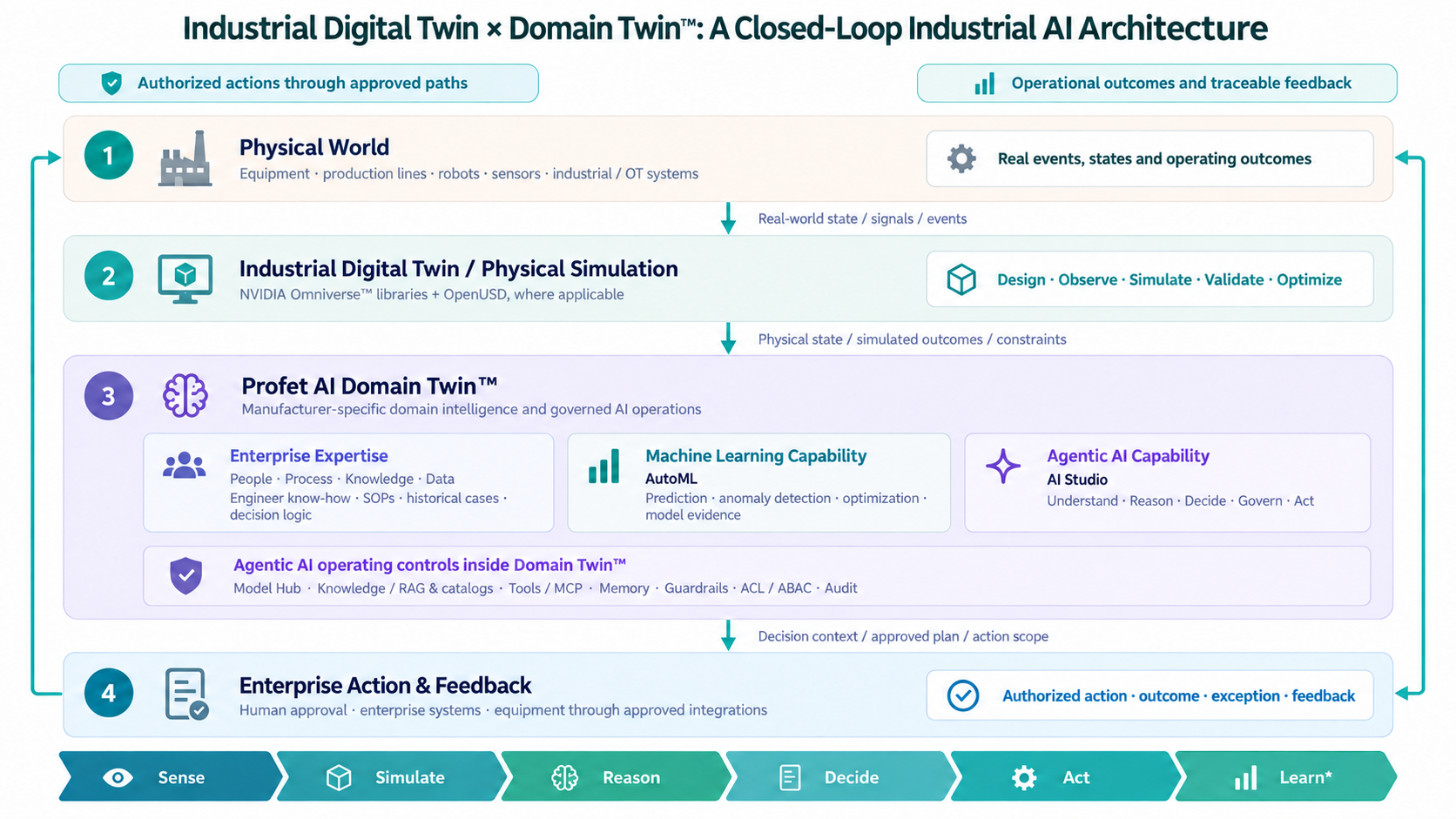
Figure 1. Complementary architecture: physical-world intelligence and Profet AI Domain Twin™ exchange state, constraints, decisions and operational feedback inside a governed closed loop. Domain Twin™ is the product layer; AutoML and AI Studio provide its Machine Learning and Agentic AI capabilities.
| Layer | Technical role | What it contributes |
|---|---|---|
| 1 · Physical world | Equipment, production lines, robots, sensors and industrial / OT systems | Generate real-world events, telemetry, operating state and execution results. |
| 2 · Industrial digital twin / Physical simulation | OpenUSD scene data and NVIDIA Omniverse capabilities, where applicable | Represent, simulate, validate and optimize the physical environment, behavior and constraints. |
| 3 · Profet AI Domain Twin™ | Enterprise expertise (People, Process, Knowledge, Data); Machine Learning capability (AutoML); Agentic AI capability (AI Studio) with Model Hub, Knowledge / RAG, Tools / MCP, Memory, Guardrails, ACL / ABAC and Audit | Turn manufacturer-specific expertise into machine-usable decision context; combine model evidence and agentic workflows; govern reasoning, authorization and action. |
| 4 · Enterprise action & feedback | Human approval, enterprise-system write-back and equipment response through approved paths | Execute only within authorized scope; retain results, exceptions and feedback for audit and governed improvement. |
Table 2. Four interacting layers connect physical-state evidence with enterprise decision logic and governed agent operation.
The most important engineering boundary sits between physical state and enterprise decision state. Asset identity, plant and line hierarchy, recipe revision, lot identity and timestamps have to align before an agent combines physical signals with enterprise knowledge. Model outputs need version and applicability context. Authorization must remain separate from reasoning: permission to inspect an event is not permission to modify a system. Treating this boundary as an explicit interface, rather than hiding it inside an LLM prompt, is what makes the architecture testable and governable.
From simulation to decision to action: a semiconductor equipment abnormality
Consider an equipment abnormality in a semiconductor factory. Equipment telemetry shows behavior drifting outside the expected operating range. A digital twin or another physical-world data and simulation layer can describe the equipment, surrounding environment and current state, and, where simulation is available, expose relevant physical constraints or the likely effect of a proposed change.
Diagnosis rarely depends on sensor data alone. An experienced engineer may correlate the alarm with maintenance history, process conditions, the active recipe and key parameters, recent lot context, prior failure cases, equipment documentation, quality data, the current SOP and analytical or AutoML model outputs. Within Domain Twin™, the Agentic AI capability can bring those sources into the same decision context, invoke approved models and tools, and compare the current event with historical cases rather than treating each source in isolation.
At that point, the agent enters a stateful enterprise workflow. It observes the event, analyzes the relevant evidence, recommends a bounded next step, validates it against operating rules and model limits, routes it through the required authorization, and only then invokes the approved action. The outcome returns to the system as traceable feedback for the next decision cycle. The result is a governed operational workflow in which AI participates under explicit enterprise controls.
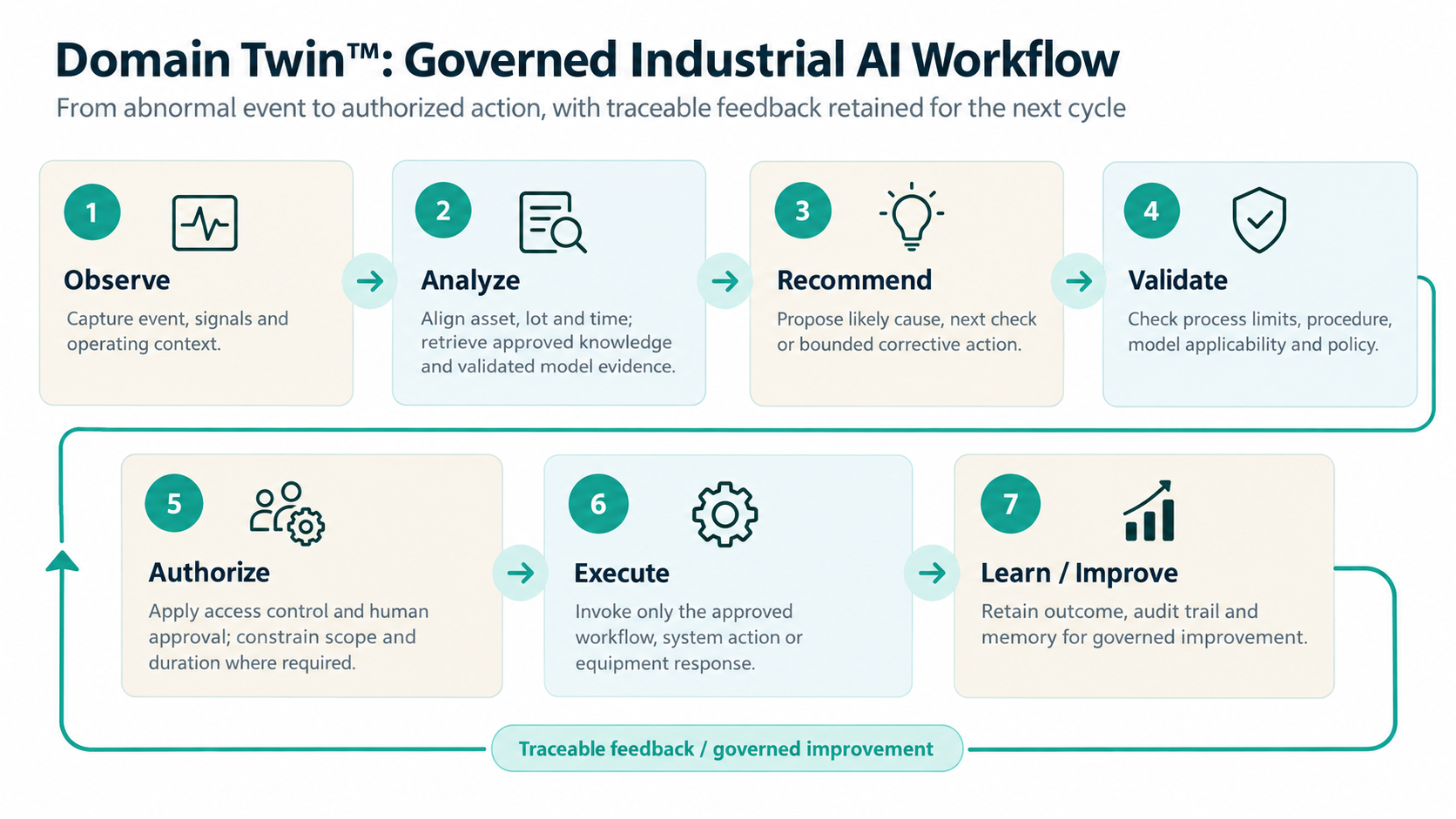
Figure 2. Domain Twin™ governed industrial AI workflow: an abnormal event moves from observation and analysis through recommendation, validation, authorization and execution, with results retained as traceable feedback.
| Step | Engineering behavior |
|---|---|
| Observe | Capture the abnormal event, equipment signals, telemetry and operating context. |
| Analyze | Correlate data, historical cases, SOPs, engineering knowledge and analytical / AutoML evidence. |
| Recommend | Propose likely causes, the next inspection or a bounded corrective action with supporting evidence. |
| Validate | Cross-check the recommendation against operating limits, approved procedures, model applicability and enterprise policy. |
| Authorize | Apply RBAC / ABAC and Human-in-the-Loop controls. Where used, issue time-bounded authorization scoped to the action and duration. |
| Execute | Invoke only the approved workflow, enterprise-system action or equipment response within the authorized scope. |
| Learn | Record outcome, audit trail and memory. Feed the result into governed knowledge, model or workflow improvement. |
Table 3. Engineering behavior behind a governed abnormal-event workflow.
Governance belongs in the runtime architecture
Once an agent can use enterprise tools, write back to systems or affect equipment, governance becomes runtime behavior. RBAC or ABAC can determine whether the agent may access a particular model, knowledge source or tool. Human-in-the-Loop controls can require a qualified engineer to approve high-impact actions. Where used, a time-bounded authorization token can constrain both permission scope and duration. Every consequential step should leave enough evidence to reconstruct what the agent saw, which sources and models it used, who approved the action and what happened afterward.
Learning belongs inside the same control model. Operational outcomes can be retained as feedback, memory and new enterprise knowledge for the next decision cycle. Model retraining, knowledge changes and workflow updates should still pass through their own validation, versioning and governance before they return to production.
How this architecture aligns with NVIDIA Physical AI
NVIDIA describes a three-computer solution for Physical AI spanning training, simulation and real-time inference and control. DGX systems support training; Omniverse and Cosmos on RTX PRO Servers support simulation; Jetson AGX systems support real-time inference and control. NVIDIA’s industrial digital twin portfolio also extends into operation and optimization. The Factory Operations Blueprint (FOX) is a reference design for building autonomous factory-manager agents that reason across live factory data and coordinate specialized agents and machines.
As NVIDIA capabilities extend into live factory operations, manufacturer-specific domain context becomes a core architecture requirement. Orchestration can coordinate agents and machines, but it cannot know a manufacturer’s recipe authority, valid SOP revision, model operating window, escalation path or plant-specific exception unless those states are represented explicitly. Domain Twin™ is designed to carry that context.
| Physical AI stage | NVIDIA role | Domain Twin™ contribution |
|---|---|---|
| Training / model development | Train and improve AI capabilities with accelerated computing and data. | Bring validated model outputs into the enterprise knowledge and decision context. |
| Simulation / digital twin | Represent, test and optimize physical environments, behavior and constraints before deployment. | Use physical state, simulated outcomes and constraints as evidence in enterprise reasoning and decision workflows. |
| Inference / factory operations | Run AI close to physical systems and coordinate operational AI patterns, including factory-agent architectures. | Apply manufacturer-specific knowledge, decision logic, permissions, approval conditions and governed workflows around what happens next. |
Table 4. NVIDIA Physical AI and Domain Twin™ address different, complementary parts of the industrial AI lifecycle.
A closed loop depends on bidirectional context and constraints
The loop is bidirectional. Physical-world systems and digital twins can provide real-time state, simulated outcomes and physical constraints to Domain Twin™ and its agents. Domain Twin™ can return enterprise goals, engineering logic, decision rules, security policy and human-approval requirements to planning and execution. Once a decision is validated and authorized, the agent can translate it into an enterprise-system action or approved equipment response. The result then returns as feedback, memory and enterprise knowledge for the next cycle.
| Exchange direction | Typical content |
|---|---|
| Physical world / Digital Twin → Domain Twin™ | Equipment state, telemetry, simulated outcomes, physical constraints and event identity |
| Domain Twin™ → planning / agent workflow | Enterprise goals, engineering logic, SOPs, model evidence, security policy and human-approval requirements |
| Agent workflow → enterprise / equipment | Recommended action, evidence summary, authorized parameters and target tool / system |
| Outcome → Domain Twin™ | System response, exceptions, engineer feedback and operating result retained as feedback, memory and enterprise knowledge |
Table 5. The operating loop closes only when context, constraints and outcomes can move in both directions.
Where Domain Twin™ fits in the NVIDIA industrial AI ecosystem
NVIDIA’s industrial AI foundation now spans digital twins, Physical AI and factory-level agent orchestration. What remains manufacturer-specific is the operating context around that foundation: recipe ownership, SOP validity, trusted historical cases, model applicability, approval matrices and the differences between products, lines, plants and regions. The more capable the horizontal foundation becomes, the more important it is to formalize this domain layer, because models, agents and physical systems need to share the same operating semantics and decision rights.
NVIDIA’s Foxconn case study illustrates the physical side of portability: standardized OpenUSD-based digital-twin assets are used to migrate and duplicate production-line layouts across global sites. That leaves a second portability problem at the enterprise layer: how the validated decision method, model applicability, SOP authority and approval boundaries travel with the line. Domain Twin™ is designed to make that operating context portable without detaching it from governance.
Domain Twin™ is Profet AI’s implementation of that manufacturer-specific layer. At the point where horizontal industrial AI enters live operations, this layer stops being an implementation detail: it is what keeps context, authority and model applicability consistent as more models, agents and physical systems participate in the same workflow. Domain Twin™ carries those operating semantics, evidence, decision rights and governance boundaries across the industrial AI stack.
In the reference architecture described here, Domain Twin™ serves as the manufacturing domain software layer. It is designed to connect NVIDIA-enabled physical intelligence with the manufacturer’s own knowledge, models, permissions and workflows and preserve that operating context as governed, auditable and reusable AI assets. At scale, what should move from one proof of concept to another line or plant is not an agent transcript. It is a validated decision method: the relevant knowledge, model evidence, operating rules, workflow and governance boundary. That is what turns a horizontal technology foundation into repeatable manufacturing capability without forcing every site to rebuild the same operating knowledge.
From higher-fidelity simulation to repeatable industrial operations
Industrial digital twins will continue to gain physical fidelity, simulation speed and operational reach. Factories also run on accumulated human experience, process knowledge, business rules, security policy and organizational responsibility. If industrial AI is expected to operate consistently beyond a single use case, those elements need a machine-usable and governable representation of their own.
Connecting the twin of the physical world with the twin of enterprise expertise creates a more complete industrial AI loop: sense what is happening, simulate what may happen, reason with enterprise context, decide within policy, act through an authorized path and retain the outcome for the next cycle.
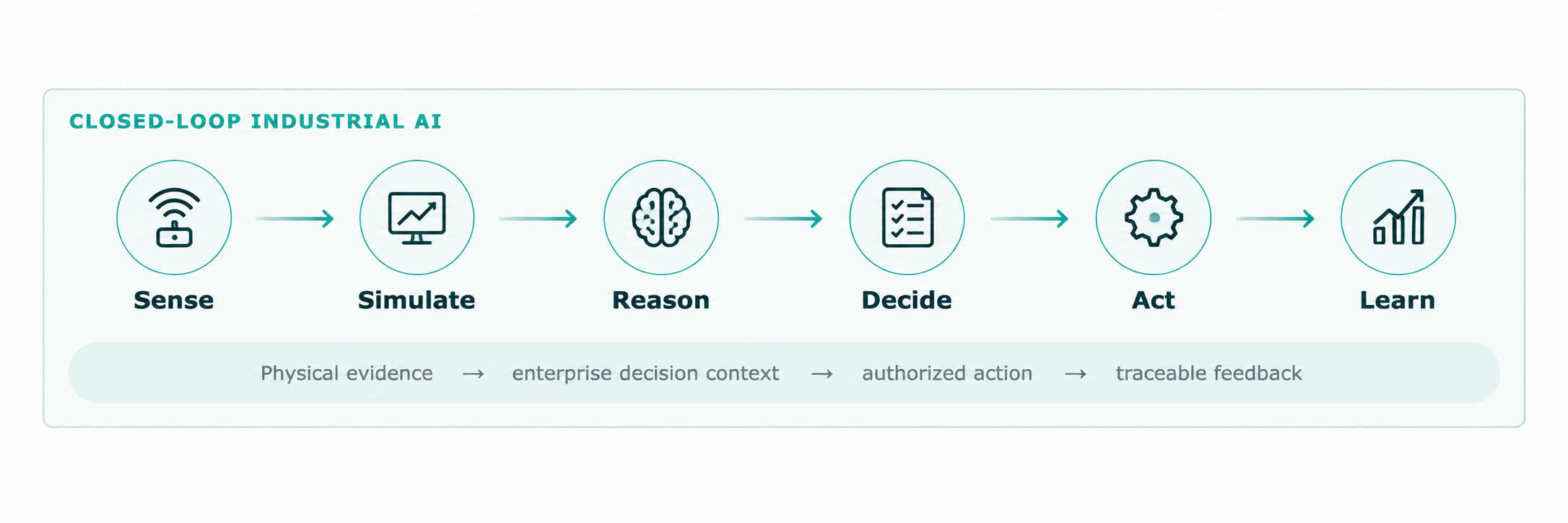
Digital twins give Physical AI a world it can observe, simulate and optimize. Domain Twin™ gives industrial AI a durable representation of enterprise expertise, model evidence, permissions and decision logic, with Machine Learning and Agentic AI capabilities operating inside the same governed context. Connected through a closed operating loop, the two create a path from physical intelligence to accountable action and from a successful use case to repeatable deployment across lines and plants. Manufacturing know-how becomes a reusable enterprise asset without losing the evidence, authority and controls that make it trustworthy.
Frequently asked questions
Does Domain Twin replace an industrial digital twin?
No. In this architecture, the industrial digital twin supplies physical state, simulation results and constraints. Domain Twin adds manufacturer-specific knowledge, model evidence, permissions and workflows for governed decisions and actions.
Does this architecture assume a ready-made NVIDIA integration?
No. This article describes a reference architecture, not a certification or a preconfigured integration. Deployment requires validating the relevant interfaces, data semantics, model applicability, access permissions and approved execution paths for each use case.
Can an AI agent change equipment settings without approval?
Only actions within the explicitly authorized scope should execute. Process limits, access controls, required human approvals and audit records define the boundary between a recommendation and an equipment or enterprise-system action.
Explore Domain Twin™ for your manufacturing workflow
Explore Domain Twin™, AutoML and AI Studio to map the knowledge, model evidence, system connections and approval points needed for your use case.