From Generative AI to Agentic AI: Why MCP Is the Missing Link

The Key Foundation for Moving from Generative AI to Agentic AI
If the first wave of AI was about teaching machines to understand and express human language, then we are now standing at the beginning of the second wave—one defined by action. This is the era of Agentic AI.
Agentic AI is no longer a passive system that merely answers questions. It acts as a digital worker with decision-making capabilities. To function effectively, it must operate across multiple systems—querying internal enterprise data, updating records, triggering workflows, or notifying stakeholders through collaboration tools.
Until recently, enabling AI to safely and reliably perform such cross-system actions came at a very high cost.
So how did AI evolve from generative models into truly agentic systems?
The key lies in today’s main topic: MCP (Model Context Protocol).
Before MCP: The “Integration Hell” Problem
Before diving into how MCP works, we need to clarify a fundamental question:
Why do AI capabilities keep improving, yet remain difficult to deploy at scale inside enterprises?
The bottleneck is rarely the model itself—it’s the fragmented data and system landscape.
Enterprise data and tools are typically scattered across different systems. Documents may live in SharePoint, manufacturing data in MES, customer information in Salesforce—each with its own interface and access rules, and no consistent way to connect them.
When enterprises want a model to access multiple systems, engineering teams often resort to the most direct approach: writing custom integration code for every model–system combination. This is commonly known as “glue code.”
In this architecture, developers must repeatedly write and maintain bespoke integrations for every pairing of model and tool. Without a standardized connection protocol, even a minor API change in one system can break dozens of downstream integrations, dramatically reducing overall system stability.
Over time, this point-to-point integration approach leads to what engineers call “integration hell.”
This results in two major consequences:
- Vendor lock-in: Once an enterprise has invested heavily in integrating a specific model, switching to another model often requires rewriting and retesting the entire integration layer.
- Reinforced data silos: Since each new data source adds incremental integration cost, enterprises tend to connect only the most critical systems, leaving many valuable but “non-core” data sources outside AI’s reach.
This is why many AI initiatives—despite having sound concepts—never move beyond pilot or demo stages. The cost and risk of integration are simply too high.
Technology and Advantages: The Three Core Components of MCP
In November 2024, U.S. startup Anthropic introduced MCP, bringing order to this chaos.
MCP is not designed to be an all-in-one super platform, nor does it force AI to learn yet another proprietary language. Instead, it defines a standardized communication protocol between AI models and external systems.
The MCP architecture consists of three components:
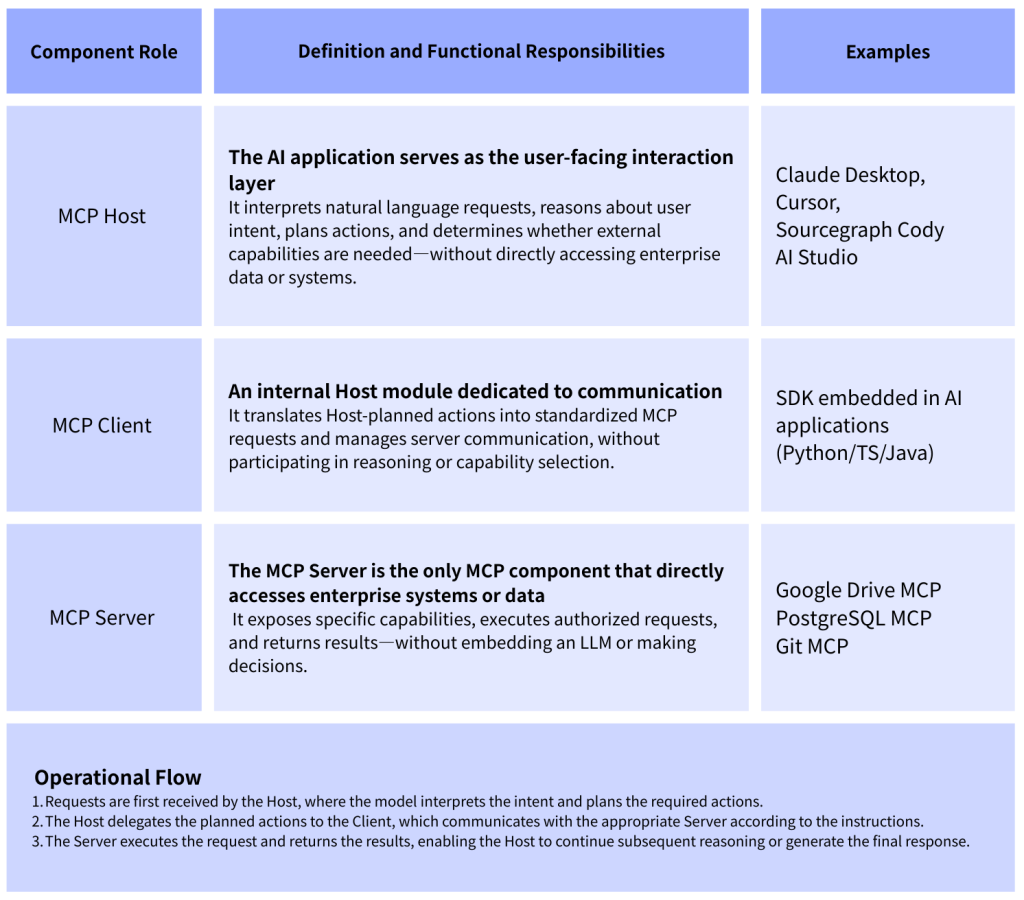
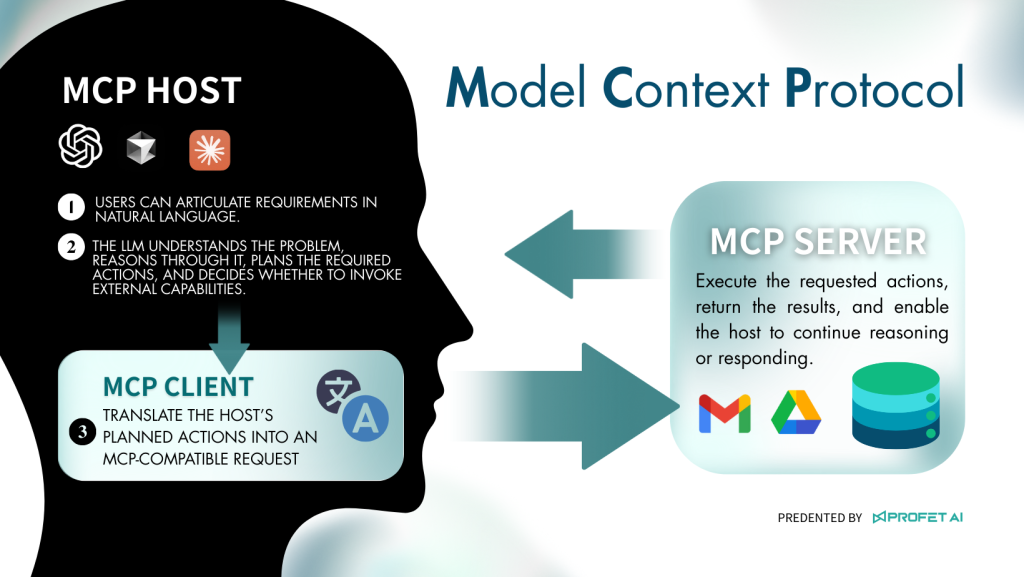
For development teams, this fundamentally changes the integration model. Instead of writing custom connectors for every AI tool or platform, teams only need to implement an MCP Server once. That server can then be reused across different AI environments—desktop AI tools, developer IDEs, or internal enterprise platforms.
When connection logic becomes reusable, integration costs stop compounding. AI application development and maintenance return to a more controllable and sustainable state. And only when integration costs are under control can Agentic AI realistically enter everyday enterprise workflows.
Beyond Integration: Security, Permissions, and Boundaries
However, even after escaping integration hell, another critical challenge remains: security and access control.
When AI becomes embedded in enterprise processes, the real question is not how much it can do—but what it is allowed to do, and whether those permissions introduce risks such as data leakage or system compromise.
In MCP’s design, AI is not granted unrestricted system access. Instead, it operates within clearly defined interaction boundaries.
In some scenarios, AI may only need read-only access to understand system states or analyze conditions. But once actions involve updating data, sending notifications, or triggering operational workflows, risk increases significantly. These actions must therefore be explicitly governed and allowed only under defined conditions.
Moreover, when users switch projects or responsibilities change, the scope of data visible to AI is updated accordingly—preventing it from retaining unnecessary long-term access.
This emphasis on clear boundaries is not theoretical. The cybersecurity incident known as Ni8mare in early 2026 served as a stark reminder: when automation or AI platforms hold both system access and cross-process control, a breach can impact not just a single tool, but entire operational workflows. At that point, risk stems from the process itself, not individual features.
For enterprises—especially in manufacturing—security also means data sovereignty. MCP does not require raw data to be sent to the cloud. Instead, it supports local data processing and filtering, passing only necessary results to models for reasoning. Data remains under enterprise control, while AI plays a supportive analytical role.
This design allows AI to gain agency while preserving what enterprises care about most: control. AI is no longer just answering questions—but every action it takes remains understandable, manageable, and auditable.
This is precisely why MCP enables Agentic AI to move from concept to practice.
MCP × AI Studio: Bringing Agentic AI into the Enterprise
MCP ensures AI can safely and controllably connect to data and systems. But in real deployments, enterprises quickly encounter the next challenge:
Once AI can read data and invoke tools, how does it actually participate in decision-making?
The key is not just connectivity, but who can see what, who can do what, and under what conditions.
Not every AI agent should have the same visibility or authority in every scenario. Access must be dynamically constrained based on job roles, contexts, and enterprise policies. Some situations allow read-only analysis; others permit action—but only within clearly defined rules.
This is where Profet AI’s AI Studio, an agentic AI collaboration platform, comes into play.
AI Studio enables multiple AI agents—each with different roles and expertise—to collaborate within a single workflow. They cross-validate insights, transform model outputs into actionable enterprise decisions, and ensure that every agent operates strictly within its permitted scope.
A Practical Example: HR Decision Support
HR is one of the most common application scenarios.
In recruitment and retention, the challenge is rarely a lack of data. Instead, the difficulty lies in converting fragmented information into predictive, actionable insights.
Within AI Studio, HR teams move beyond static reports and begin collaborating with AI agents in real decision-making processes. For example, in hiring or retention scenarios, AI can securely analyze historical data and predict attrition risks—allowing HR to intervene before critical decisions are made or problems escalate.
Because HR data is highly sensitive, not every role or situation has full visibility. Through MCP’s permission controls and AI Studio’s collaboration framework, AI agents only access what they are explicitly allowed to see and act upon.
Data ownership remains with the enterprise. AI becomes a decision-support capability—not an additional source of risk.
From Operations to Strategy
From manufacturing floors to core HR decisions, MCP opens the door for Agentic AI to enter enterprise systems, while AI Studio provides the environment for these agents to collaborate, reason, and form judgments together.
When AI evolves from a data-retrieval tool into a system that can predict risk, support decisions, and recommend actions, Agentic AI finally becomes embedded in the core of the enterprise value chain.