From SEMI E187 to Agentic AI Governance: Semiconductor AI Security Can No Longer Stop at the Equipment Layer
Profet AI hosts Crossover Talks in Hsinchu with Taisys, Zentera Systems, and HPE to explore security governance architecture for Agentic AI
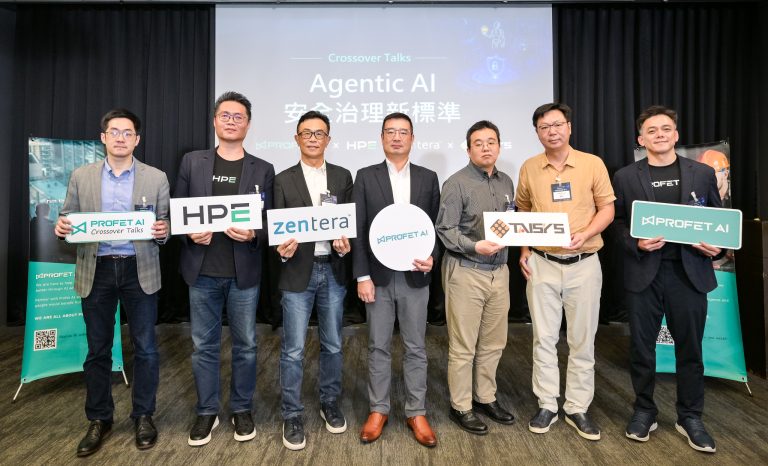
Semiconductor equipment cybersecurity is moving from standard-setting to procurement, validation, and supply-chain implementation.
SEMI E187 has given the industry a more consistent baseline for cybersecurity requirements in fab equipment. For semiconductor manufacturers and equipment suppliers, this means cybersecurity is no longer something to be added later by IT. It must be built into equipment across design, deployment, operation, and maintenance.
But this is only the starting point.
As AI agents begin entering the factory, reading process data, connecting to MES, EAP, FDC, and ERP systems, and participating in task execution, the security question is no longer limited to whether the equipment itself is secure.
The more critical questions become:
・Who issued the instruction?
・Was the action initiated by a person, or executed on their behalf by an AI agent?
・Does the agent have the right permissions?
・Which tools did it call, what data did it access, and which systems did it connect to?
・If abnormal behavior occurs, can the enterprise stop it in real time, trace the full sequence of actions, and audit it afterward?
This is the new governance challenge brought by Agentic AI.
SEMI E187 Addresses Equipment Security. AI Agents Extend Governance Upward.
The importance of SEMI E187 lies in its ability to establish a clearer cybersecurity baseline for semiconductor fab equipment. As equipment becomes increasingly connected within production environments, its built-in security posture directly affects line stability, operational continuity, and supply-chain resilience.
But Agentic AI changes the shape of risk.
In the past, equipment and enterprise systems were mostly operated by people. Accounts, permissions, network boundaries, and operation logs were largely designed around human users. In the Agentic AI era, AI is no longer limited to answering questions. It may act on behalf of users, access data, call tools, connect systems, and execute multi-step workflows across enterprise environments.
This means companies can no longer focus only on whether the equipment is secure. They must also ask whether the behavior around equipment and systems is secure.
In other words, SEMI E187 is an important starting point for equipment cybersecurity. But as AI agents move closer to equipment, data, and operational workflows, enterprises need to extend governance upward into identity, platform control, network security, and AI runtime infrastructure.
The Risk of Agentic AI Comes Not Only from the Model, but from Behavior
In the early stages of generative AI adoption, enterprise security discussions often focused on data leakage, hallucination, and whether employees were entering sensitive information into external tools.
Those risks still matter. But Agentic AI goes further.
The defining difference of an AI agent is that it can act. It can read data, interpret tasks, call tools, execute workflows, and decide the next step based on context. Once an AI agent is granted system access, the risk is no longer limited to inaccurate answers. It may come from incorrect actions, excessive permissions, unauthorized tool use, or behavior that takes place outside the enterprise’s visibility.
This is why Agentic AI governance cannot stop at model safety.
Enterprises need to manage:
Whether the agent’s identity is trustworthy
Whether its permissions match the task
Which tools and data the agent is allowed to use
Whether its behavior follows an approved path
Whether every access, action, exception, and escalation leaves an auditable record
As AI moves from being a tool to becoming a digital worker, the center of governance shifts from protecting systems to governing behavior.
A Four-Layer Architecture: Governing AI Agents from Intent to Action
To prepare for the Agentic AI era, enterprises cannot rely on isolated tools or single-point security controls. They need a connected governance architecture that spans identity, platform, network, and runtime infrastructure.
Layer 1: Identity and Authorization
When AI agents begin executing tasks on behalf of users, identity verification can no longer stop at confirming whether an account has logged in successfully.
Enterprises need to distinguish whether an action was initiated directly by a person or executed by an AI agent. If it was executed by an agent, which user, department, or workflow does that agent represent? If the action involves a high-risk operation, should a human approval step be required before execution?
This is where Taisys plays an important role in the architecture. By supporting trusted identity and human-in-the-loop authorization, enterprises can retain a clear confirmation point before AI agents perform sensitive operations. This helps prevent agents from executing high-impact actions without verified user intent.
This will be especially important in future factory environments. As AI agents gradually support equipment monitoring, data retrieval, workflow recommendations, and task execution, people may not manually operate every system. But they still need to retain control over critical decisions and high-risk actions.
Layer 2: Platform Governance
For Profet AI, the key to Agentic AI is not only building agents. It is operating and governing them.
Enterprises will not have just one AI agent. They will have many agents across departments, workflows, sites, and operational tasks. These agents may connect to different data sources, call different tools, use different models, and accumulate different forms of domain know-how and skills.
Without unified platform governance, AI agents can easily become another form of Shadow AI. They may appear to improve efficiency on the surface, while the enterprise loses visibility into which agents are running, what data they are using, which tools they are calling, what records they leave behind, and how problems can be traced when something goes wrong.
This is where Domain Twin™ provides value.
Domain Twin™ helps manufacturers start from their own domain and bring together data, workflows, know-how, permissions, tools, and audit trails into a governable AI operating environment.
At the platform layer, enterprises need to govern not only conversations, but the entire operating context of the agent. This includes model configuration, tool use, knowledge-base access, ACLs, guardrails, tool permissions, audit logs, and the security of external skills or MCP tools.
AI agents should not only know how to act. They must also know what they are allowed to do, what they are not allowed to do, and why each action was taken.
This is one of the most critical, and often underestimated, layers for manufacturers moving AI from isolated applications into real operations.
Layer 3: Network Security and Zero Trust
When AI agents begin connecting to equipment, systems, databases, and application services, network-layer governance must also evolve.
In the past, enterprises often assumed that internal networks were relatively trusted. In the Agentic AI era, that assumption becomes more dangerous. Because AI agents can act with greater autonomy and speed, excessive permissions, incorrect instructions, malicious prompts, or external compromise can allow abnormal behavior to spread more quickly.
Zentera Systems’ Zero Trust architecture plays a key role at this layer. Its focus is not assumed trust, but continuous verification, least privilege, connection tracking, and anomaly containment.
If platform governance defines the approved path an agent should follow, network governance helps verify whether the agent is actually operating within that path.
Is the agent connecting only to approved systems?
Is it attempting to access data it should not touch?
Is there lateral movement or unauthorized access?
Can abnormal behavior be isolated or blocked when it occurs?
These capabilities will determine whether enterprises can safely allow AI agents to participate in mission-critical workflows.
Layer 4: AI Runtime Infrastructure
For Agentic AI to enter enterprise operations, companies cannot focus only on the application layer. They must also consider the compute, deployment, and operational infrastructure behind it.
HPE’s role in this architecture is not to directly address SEMI E187 equipment compliance. Rather, HPE provides enterprise-grade compute and infrastructure support so that AI agents can run in on-premises, edge, or data-center environments with greater security, stability, and manageability.
As AI agents move closer to the factory floor, enterprises must govern not only agent identity and permissions, but also the infrastructure that carries AI workloads. That infrastructure must be secure, reliable, maintainable, and suitable for long-term operations.
For semiconductor and high-tech manufacturers, AI is not finished once it is deployed. It must be operated over time, managed across sites, maintained reliably, and balanced across security, performance, and availability.
This is often one of the most overlooked foundations when companies try to move AI from PoC to ROI.
From Equipment Compliance to Operational Governance
The semiconductor industry is now facing the convergence of two forces.
On one side, equipment cybersecurity is becoming more standardized, procurement-driven, and validation-oriented. SEMI E187 reflects the industry’s expectation that equipment should have a clearer security baseline before entering the fab environment.
On the other side, Agentic AI is pushing AI beyond knowledge search and assisted analysis, moving it closer to process data, equipment, enterprise systems, and operational workflows.
When these two forces converge, the question is no longer only:
Is this equipment secure?
Is this model useful?
Can this agent complete the task?
The more important question becomes:
Can the entire chain of AI-driven behavior be governed when an agent begins interacting with core enterprise assets?
This is the next challenge for semiconductor and high-tech manufacturers.
AI agents may support quality anomaly analysis, equipment status interpretation, process parameter recommendations, engineering troubleshooting, cross-site knowledge reuse, and even supply-chain or customer workflow coordination. These scenarios involve years of accumulated manufacturing know-how and highly sensitive operational data.
Without governance, the more powerful AI becomes, the greater the operational risk may be.
With the right governance foundation, AI can become a scalable operating capability that helps enterprises preserve knowledge, shorten decision cycles, and improve consistency across sites.
The Advantage of Agentic AI Depends on Whether Enterprises Control Their Own Domain
For manufacturers, the most valuable AI will not come from generic models alone. It will come from the enterprise’s own domain.
Data, workflows, equipment experience, exception-handling logic, engineering judgment, quality knowledge, and cross-site deployment experience are the real sources of manufacturing competitiveness.
This is why the key to Agentic AI is not handing enterprise know-how to external tools. It is converting that know-how into AI assets the enterprise can govern, reuse, and trace.
This is the core positioning of Domain Twin™.
Domain Twin™ helps manufacturers transform frontline know-how dispersed across people, equipment, workflows, and systems into governable and reusable AI assets. When AI agents operate based on the enterprise’s own domain, and are governed across identity, permissions, tools, network boundaries, and runtime infrastructure, AI can move from isolated tools into real operational capability.
For manufacturers, this is not just a technology upgrade. It is also a matter of knowledge retention, operational control, and long-term competitiveness.
SEMI E187 Is the Starting Point. Agentic AI Governance Is the Next Step.
SEMI E187 reminds the industry that equipment cybersecurity must be considered from the design stage.
Agentic AI adds another layer of urgency: when AI begins participating in operations and decisions, governance must also be designed before deployment.
These are not competing concepts. They are connected.
SEMI E187 establishes an important security baseline for equipment. In the Agentic AI era, enterprises need to extend upward into identity, platform governance, network security, and AI runtime infrastructure, so that AI agent behavior can be authorized, controlled, traced, and audited from intent to action.
In the future semiconductor factory, people, AI agents, equipment, and systems will work more closely together. People will still be responsible for critical judgment and authorization. AI agents will connect data, tools, and workflows. Equipment and systems will carry increasingly real-time and complex production tasks.
In this environment, enterprises do not need more AI tools that cannot be governed. They need a governance foundation that allows AI to enter operations safely.
AI agents are fast and powerful. But the more autonomous they become, the less enterprises can afford to focus only on functionality.
Agentic AI that can truly enter real operations must be authorized, controlled, traced, and audited.
This will be a critical step for semiconductor and high-tech manufacturers moving from AI PoC to measurable ROI.
Profet AI helps manufacturers build a governable, auditable, and secure foundation for Agentic AI through Domain Twin™, enabling AI to move beyond proof of concept and safely enter real operations.
If your organization is evaluating AI agents, preparing for SEMI E187-related cybersecurity requirements, or looking to move AI from isolated tools into governable operational capability, please fill out the form below to connect with the Profet AI team.