When AI Stops Answering Questions and Starts Taking Action
Why Enterprises Are Moving Toward Agentic AI

From Personal Productivity to Enterprise Operations, Where the Gap Emerges
Over the past two years, Generative AI has rapidly reshaped how people work. From document drafting and data organization to content creation, general-purpose models such as ChatGPT have delivered significant productivity gains at the individual level.
However, enterprise adoption tells a very different story. According to The ROI of AI 2025 report published by Google Cloud, while more than 90% of enterprises have launched AI initiatives, the vast majority remain stuck at the proof-of-concept (PoC) stage. Only a small group of leading organizations have successfully scaled AI into core operational processes and achieved sustained, measurable business impact.
These findings point to a fundamental issue. The role enterprises require from operational-grade AI is fundamentally different from the role played by today’s conversational AI.
The Core Problem, Crossing the Gap from “Responder” to “Actor”
If model capabilities continue to improve, why do enterprise AI projects still struggle to move beyond PoC?
A closer look at how AI is typically used in PoC deployments reveals a common pattern. AI is primarily tasked with answering questions, generating content, or offering recommendations. This mirrors the design logic of ChatGPT, where AI functions as a passive responder.
Yet in real operational environments, enterprise needs extend far beyond information delivery. Enterprises require AI to support:
- Executable decisions, insights must translate into concrete actions
- Process continuity, actions must connect across multiple internal systems
- Accountability and traceability, outcomes must be reviewable, correctable, and auditable
When a system optimized for conversational quality is expected to handle permissions, workflows, and responsibility, friction is inevitable. This helps explain why many PoCs appear promising in isolation but fail to transition into production environments.
Agentic AI, Redefining AI’s Role Inside the Organization
Against this backdrop, Agentic AI has emerged as a critical path forward.
Unlike general-purpose generative models focused on producing better answers, Agentic AI is designed to plan and execute tasks proactively, within predefined rules and under human supervision. The objective is not better responses, but reliable and repeatable action.
This shift brings three fundamental changes to AI’s role in enterprises.
1. From Data Access to Authorized Action
In traditional architectures, enterprise AI discussions often center on whether a model can access data. In practice, what enterprises truly care about is whether data can be used securely, compliantly, and within governance constraints.
Core enterprise knowledge is typically embedded in systems such as ERP, CRM, internal SOPs, and historical transaction records. These data sources are highly contextual and often sensitive. Once AI begins participating in real operations, enterprises must ensure two things.
First, the AI must understand sufficient business context to support meaningful decisions.
Second, data access and usage must remain controlled, auditable, and compliant with governance policies.
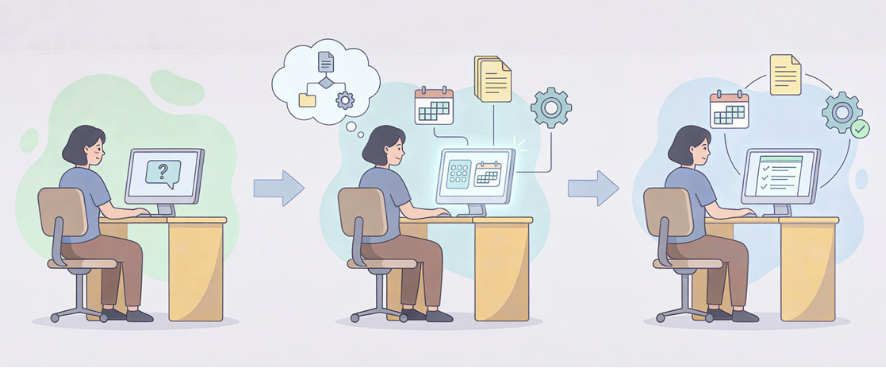
Agentic AI changes the equation by introducing AI as an authorized system actor. Under platform-level governance and permission controls, AI can not only retrieve enterprise knowledge but also, within approved boundaries, interact with systems through APIs and workflows.
This approach establishes clear behavioral boundaries for AI. Enterprises can gradually expand AI’s operational role while maintaining data sovereignty and compliance, laying a solid foundation for trust in AI-driven task execution.
2. From Recommendations to Completed Actions
The primary value of general-purpose models lies in analysis and recommendation. For enterprise leaders, however, insights alone are insufficient unless they reliably translate into downstream actions.
In practice, enterprises expect outcomes such as:
- Inventory analysis that automatically generates replenishment requests and triggers procurement workflows
- Equipment status assessments that create maintenance tickets and notify relevant teams
- Workflow conditions that automatically update system states or initiate approval processes
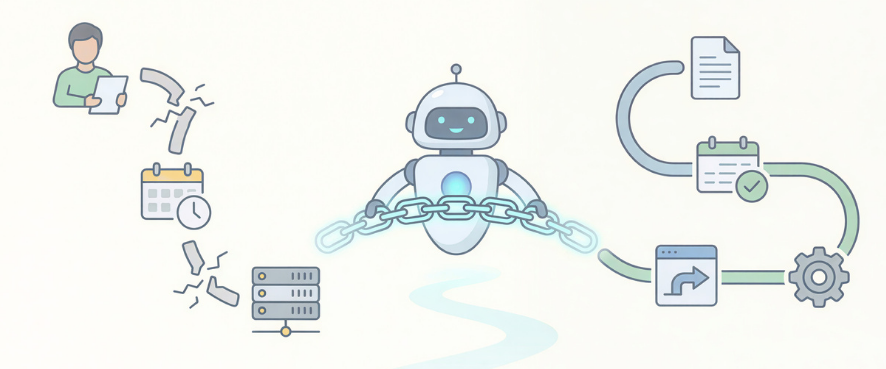
Agentic AI is designed to close this execution gap. Through workflow orchestration, tool invocation, and system integration, AI can turn decisions into concrete actions, such as creating tickets, updating records, triggering approvals, or sending notifications, all within authorized boundaries. Human checkpoints can still be retained at critical stages to balance efficiency and risk.
Once AI can actively move processes forward, it becomes a functional node within operational workflows rather than a passive advisory tool.
3. From Black-Box Outputs to Governable Decisions
As AI becomes embedded in higher-impact tasks, enterprise expectations around trust and reliability rise accordingly.
Because general-purpose models rely on probabilistic generation, they may produce responses that appear plausible but lack sufficient grounding. In high-stakes business decisions, this risk becomes unacceptable.
Agentic AI addresses this challenge by embedding decision-making within an explicit governance framework. In enterprise-grade architectures, every AI decision and action must meet clear criteria:
- Grounded reasoning, decisions are based solely on approved enterprise data sources
- Traceability, actions can be traced back to documents, system records, or defined rules
- Monitoring and auditability, decision processes and outcomes can be reviewed and audited
- Right to refuse, the system can decline to act when data is insufficient or confidence is low
In this model, trust is built not on eloquence, but on consistency, predictability, and auditability. These qualities are essential for AI to participate in long-term operations rather than remain a short-lived experiment.

Scaling Deployment, The Real ROI Inflection Point
Google Cloud’s research further confirms that AI ROI is strongly correlated with deployment depth.
Among early adopters of Agentic AI, more than 80% report clear and measurable business returns. What distinguishes these leaders is a shared mindset shift. They move beyond isolated experiments and treat AI as scalable digital labor.
Only when AI can independently complete tasks within a governance framework can organizations progress from productivity assistance to true operational automation, unlocking exponential value creation.
Conclusion, Enterprise AI Advantage Comes from Deep Integration
The evolution from GPT-style models to Agentic AI reflects a pragmatic shift in enterprise expectations. When organizations demand not just correct answers, but the ability to safely get work done, deep integration into existing processes becomes the decisive factor.
Within this context, Profet AI’s AI Studio (AIS) was purpose-built to meet enterprise Agentic AI requirements. Through no-code workflow orchestration and rigorous permission governance, AIS provides a secure and controllable foundation for deploying Agentic AI in production environments.
By bridging the gap between conversational AI and actionable AI, Profet AI enables enterprises to transform daily operations into continuously compounding operational intelligence, turning AI from a tool into a true organizational capability.